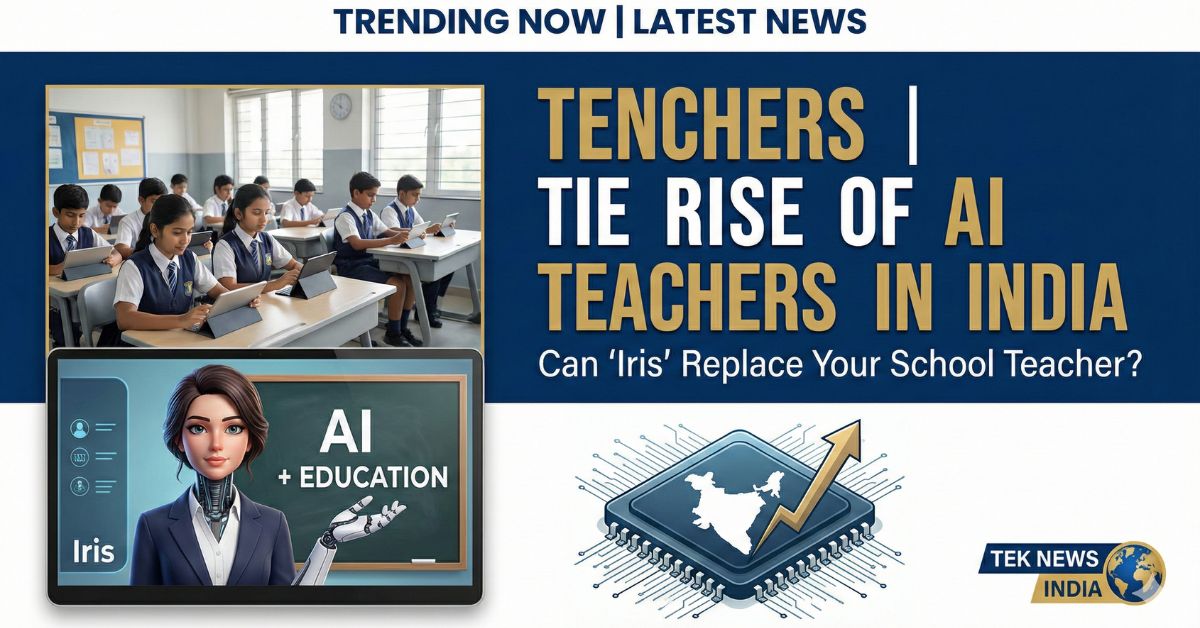
Imagine walking into a classroom in Kerala and seeing a teacher in a saree. She greets you, answers your questions about complex math problems, and even shakes your hand. But there is a twist—she is not human. This is Iris, India’s first AI teacher robot, introduced in early 2024.
Since the launch of Iris and the rapid rise of tools like ChatGPT and Google Gemini, a big debate has started across India: Will AI teachers eventually replace human teachers?
Parents are worried, teachers are curious, and students are excited. But the answer isn’t a simple “yes” or “no.” It is much more interesting. Let’s dive into the reality of AI in Indian schools, looking at the benefits, the limitations, and what the future really holds for education in our country.
The Rise of AI in Indian Classrooms
India is adopting educational technology faster than almost any other country. Recently, Google India announced major grants to organizations like Wadhwani AI to build smart learning tools for millions of Indian students.
We are seeing two types of “AI Teachers” emerge:
- Humanoid Robots: Like Iris in Kerala, which can move, talk, and answer voice commands.
- Digital AI Tutors: Apps and software that adapt to a student’s learning speed (like Byju’s, Khan Academy, or government initiatives under the National Education Policy).
These tools are not just sci-fi dreams anymore; they are slowly becoming part of our daily school life.
Advantages of AI Teachers: Why Are They Trending?
AI brings superpowers to the classroom that no single human can match. Here is why technology experts are pushing for AI in education:
1. 24/7 Availability
A human teacher needs rest. An AI teacher can explain a chemistry concept at 2 AM just as patiently as it does at 10 AM. For students preparing for tough exams like JEE or NEET, this constant support is a game-changer.
2. Personalized Learning for Every Child
In a typical Indian classroom of 40 to 60 students, a teacher cannot focus on everyone at once. AI changes this. It can analyze that a student is weak in Algebra but strong in Geometry and adjust the homework accordingly. It acts like a personal tuition teacher for every single student.
3. No Bias or Patience Issues
AI never gets tired, angry, or frustrated. It will explain the same concept 100 times without scolding the student. It treats every student equally, regardless of their background or past grades.
Why Human Teachers Are Irreplaceable (The “Guru” Factor)
Despite the cool technology, experts agree that AI cannot fully replace a human teacher. In India, we value the Guru-Shishya parampara (teacher-student bond), which relies on emotional connection.
1. Emotional Intelligence (EQ)
If a student is crying because they failed a test, an AI robot can only offer a generic response. A human teacher can offer a hug, a kind word, and real motivation. Machines can teach logic, but only humans can teach life values, empathy, and resilience.
2. Critical Thinking and Creativity
AI is great at giving facts, but it often struggles with “out of the box” thinking. Human teachers inspire curiosity. They teach students how to question things, debate topics, and think creatively—skills that are crucial for the real world.
3. Moral and Social Guidance
Schools are not just about marks; they are about becoming good citizens. An AI cannot teach discipline, teamwork, or leadership during a sports match. These social skills are learned by watching and interacting with human mentors.
The Reality in India: Major Challenges
While we talk about robot teachers, we must look at the ground reality. A full takeover by AI faces massive hurdles in India:
- The Digital Divide: While city schools might have tablets and Wi-Fi, many rural schools still struggle with basic electricity and internet. Implementing high-tech AI teachers in remote villages is currently very difficult.
- Cost: Robots like Iris and premium AI software are expensive. Most government and budget private schools cannot afford them yet.
- Language Barriers: While AI is improving in Hindi and regional languages, it often struggles with the thousands of local dialects spoken across India.
The Future: The Hybrid Model
So, what happens next? The future involves Collaboration, not Replacement.
The most likely scenario for Indian education is a Hybrid Model.
- AI will handle the “Boring” Work: It will check homework, grade papers, and teach basic facts.
- Humans will handle the “Important” Work: Teachers will focus on mentoring, leading discussions, solving complex emotional problems, and guiding students’ careers.
Recently, the Indian government and tech giants have emphasized that AI is a tool to empower teachers, not to fire them. It helps teachers save time so they can focus on what they do best: connecting with students.
Read More : Jio AI Education Initiative:
Frequently Asked Questions (FAQs)
Q1: Is the ‘Iris’ robot teacher available in all Indian schools?
No. Currently, Iris was introduced as a pilot project in a school in Thiruvananthapuram, Kerala. It is not yet available nationwide, but similar technologies are being tested in other private schools.
Q2: Will AI teachers take away jobs from human teachers?
It is unlikely. Instead of taking jobs, AI will change the job description. Teachers will need to learn how to use AI tools. The demand for teachers who can work with technology will actually grow.
Q3: Can AI teach values and discipline?
No. AI acts based on data and algorithms. It does not have feelings or life experience. Teaching values, discipline, and kindness requires a human role model.
Q4: Is AI education expensive for parents?
Right now, high-end AI tools are costly. However, many free or low-cost apps (supported by companies like Google and the Indian government) are making AI tutoring accessible to the general public.
Q5: What is the Indian government’s stance on AI in schools?
The government supports AI usage. Under the New Education Policy (NEP) 2020, there is a strong focus on integrating technology and coding into the curriculum to make students future-ready.