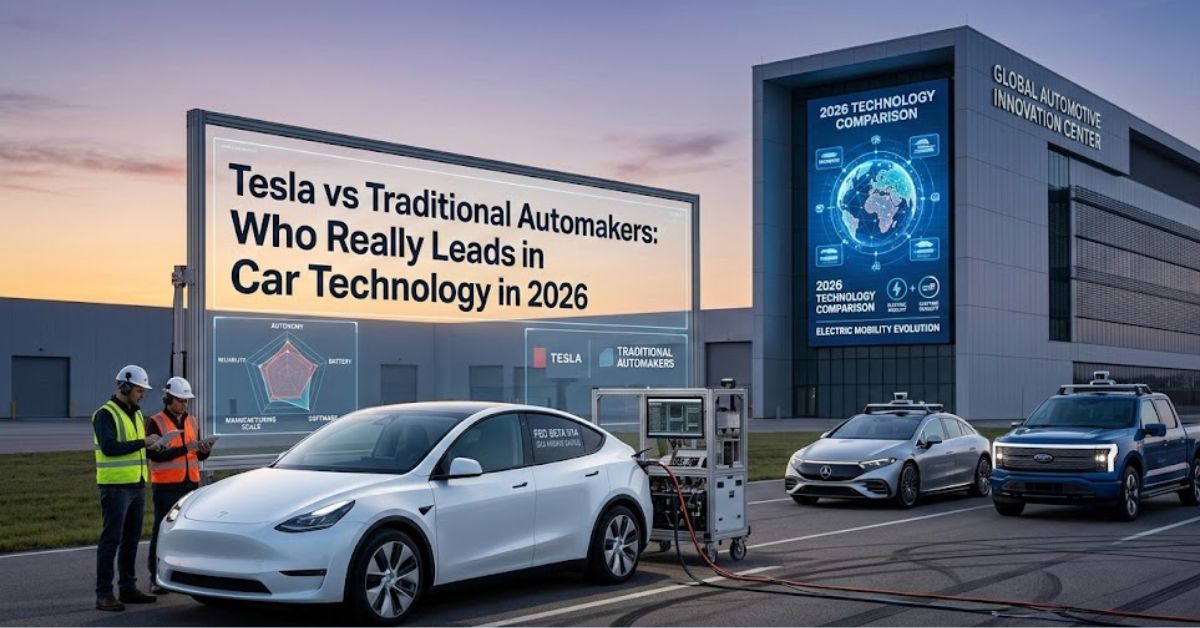
The global car industry is rapidly changing. A newer company like Tesla has shaken up the automotive world and raised big questions about who really leads in car technology today. Traditional carmakers like Toyota, Ford, Honda, Mercedes and Volkswagen have dominated for decades with millions of cars sold worldwide. But in recent years, electric vehicles, autonomous driving, software-defined features and connected car technology have re-mapped the rules of competition. This article explains the latest in this important industry shift — focusing on the technology race between Tesla and traditional automakers, and why it matters for India and the world.
How Tesla Changed the Game
Tesla was founded in 2003 and, over about two decades, pushed electric vehicles (EVs) from a niche idea to a mainstream reality. Its early Roadster, followed by the Model S, Model 3 and Model Y, helped make EVs desirable and practical, with long range and strong performance. Tesla’s rise has been marked by pioneering battery technology, advanced software systems, and features like over-the-air (OTA) updates that can improve cars long after they are sold. These OTA updates allow Tesla cars to gain new functions or fixes without a dealer visit — a concept more common in smartphones than older cars.
This tech-first approach has led to Tesla being seen by many as not just a carmaker, but a technology company that happens to make cars. In fact, some analysts consider it closer to tech firms like Apple or Google in how it builds software and integrates computing power into vehicles.
Traditional Automakers and Their Strengths
Legacy carmakers have strong advantages built over decades: large manufacturing networks, deep supply chains, brand loyalty, and expertise in producing millions of vehicles every year. Companies like Toyota and Volkswagen remain leaders in global vehicle volume and have massive experience building reliable cars of all types. In terms of sheer production scale and diverse markets, traditional players still hold ground.
However, when it comes to software and digital systems, many of these companies started from a different base. Historically, traditional automakers treated software as a secondary part of the car, often buying components from third-party suppliers and integrating them later. This has made their development cycles longer and less flexible than Tesla’s unified in-house process.
Where Technology Competition Is Happening
Electric Powertrains and Batteries
Tesla’s focus on vertical integration — making many key parts like batteries, motors and software in-house — gives it control over design and performance optimization. Traditional companies are catching up, investing heavily in EV platforms, partnerships, and new factories. The shift toward electrification is global, but Tesla still leads in market perception and battery-related innovation.
Software and Autonomy
One of Tesla’s biggest claims is in autonomous driving. Its advanced driver-assistance systems are sold as options and updated frequently. Traditional automakers are investing millions in autonomous and driver-assist tech, but many still lag behind in full self-driving capability and frequent OTA updates. A recent industry analysis shows traditional manufacturers prioritizing the shift to software-defined vehicles, but Tesla and other tech-native companies currently rank higher in adoption.
User Experience and Connectivity
Tesla’s cars are known for large central screens, minimal physical buttons, and software-led interfaces. Traditional automakers are now redesigning new models with improved digital cockpits, better connectivity, and infotainment systems to meet customer expectations shaped by Tesla and modern smartphones. While this trend is recent, the gap is narrowing as more tech joins every new car.
Why This Matters for India
India is one of the fastest-growing auto markets in the world. As EV adoption increases, technology leadership will shape product availability, customer expectations, and charging infrastructure. Tesla has hinted at interest in expanding charging networks and potential models targeted at mass markets, though no official India launch plan has been confirmed yet.
For Indian consumers, the competition between Tesla-style innovation and established automaker reliability means more choice. Traditional brands like Tata, Mahindra and Hyundai are rapidly increasing EV offerings in India, focusing on affordability and service.
At a policy level, India’s push toward emission reductions, EV adoption targets and incentives for local manufacturing align with global trends. The competitive pressure from innovation may help accelerate infrastructure and technology adoption in the Indian market.
What’s Next in the Tech Race?
The automotive industry’s future will likely blend digital innovation with traditional manufacturing strengths. Tesla continues to push software updates and autonomous tech, while legacy carmakers are investing heavily in EV and software development to stay relevant. Market valuations, global competition, and consumer demand for connected, efficient and safe cars will keep this rivalry alive.
Read More : Mercedes-Benz V-Class vs Toyota Vellfire
Emerging trends like robotaxis, AI-driven driving, and smart energy integration (cars as part of home or grid energy systems) are already part of the discussion, with multiple players beyond Tesla entering the space.
FAQ
Is Tesla ahead of all traditional automakers in technology?
Tesla leads in areas like software integration, OTA updates and EV performance. But traditional automakers still compete strongly in manufacturing scale, reliability and global sales.
Do traditional carmakers make electric vehicles?
Yes. Companies like Toyota, Volkswagen, Hyundai and others have launched many EV models and are investing heavily in future EV platforms to compete with Tesla.
Will Tesla sell cars in India soon?
There has been interest and speculation about Tesla entering India, but as of now, no confirmed launch plan has been officially announced by the company.