If you have been looking to buy a new car in India recently, you must have noticed a special badge on the back of popular SUVs and hatchbacks—“Turbo”, “T-GDi”, or “TSI”.
A few years ago, turbo engines were only found in expensive sports cars or big diesel SUVs like the Fortuner and Scorpio. Today, even small family cars like the Tata Nexon, Hyundai Venue, and Maruti Fronx come with “Turbo Petrol” engines.
But what exactly is a turbo engine? Is it just a marketing gimmick, or does it actually make your car faster? And most importantly for Indian buyers—does it give good mileage?
Here is a simple, expert guide to understanding turbo engines in India.
Simple Explanation: How Does a Turbo Engine Work?
To understand a turbo engine, think of how a human breathes while running.
When you run fast, you need more oxygen to generate energy. If you can force more air into your lungs, you can run faster. A Turbocharger does exactly this for a car engine.
In a normal (naturally aspirated) engine, the car sucks in air naturally. In a Turbo engine, a small fan (turbine) forces extra air into the engine at high speed.
- More Air + More Fuel = Bigger Explosion.
- Bigger Explosion = More Power.
The “Free” Energy Trick The smartest part is how the turbo runs. It doesn’t use the engine’s power (like a battery or belt). Instead, it uses the exhaust gas (smoke coming out of the silencer) to spin a fan. This fan pushes fresh air back into the engine. It effectively recycles “waste” energy to give you a power boost.
Why Are Turbo Engines Suddenly Popular in India?
You might wonder, why are companies like Tata, Mahindra, Hyundai, and Skoda suddenly putting small 1.0-litre turbo engines in big SUVs?
1. The “Small Engine” Tax Benefit
In India, cars shorter than 4 meters with petrol engines smaller than 1.2 litres pay less tax. Car makers use a small 1.0L engine to save tax but add a Turbo to make it powerful enough for a big SUV. You get the power of a big engine with the tax benefits of a small one.
2. Strict BS6 Emission Norms
Government rules (BS6 Phase 2) require cars to pollute less. Small turbo engines burn fuel more efficiently when driven carefully, producing less CO2 compared to older, bigger engines.
3. The “Punch” Factor
Indian drivers are now driving more on highways and expressways. We want cars that can overtake quickly. Turbo engines provide a sudden “kick” of power (Torque) which makes overtaking trucks and buses very easy.
The Good and The Bad (Pros & Cons)
Before you buy a turbo car, you must know the reality of living with one in Indian traffic.
The Advantages (Why you will love it)
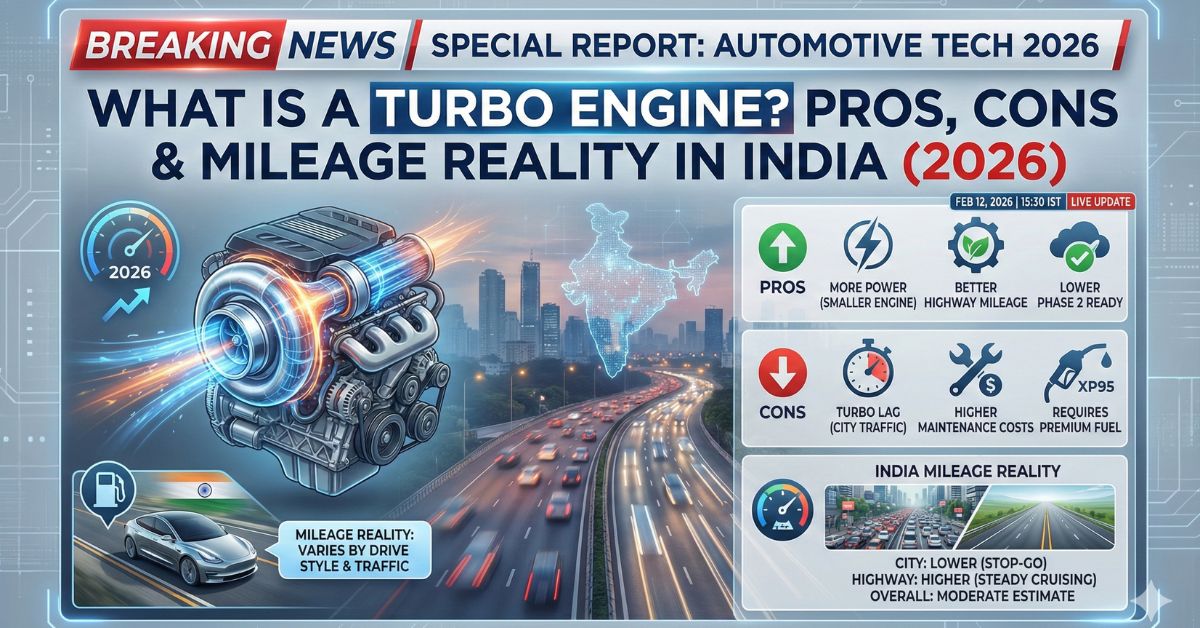
- Massive Power: A tiny 1.0L Turbo engine can produce more power (120 BHP) than a large 1.5L normal engine.
- Fun to Drive: When the turbo kicks in (usually after 2000 RPM), you feel a push back in your seat. It makes driving exciting.
- High Torque: Great for climbing hills or driving with a full load of passengers.
The Disadvantages (The “Mileage” Reality)
- The “Turbo Lag”: When you press the accelerator, there is a delay of about 1 second before the power comes. This is called “Turbo Lag.” In bumper-to-bumper city traffic, this can be annoying.
- Sensitive Mileage: This is the biggest shock for Indian buyers. If you drive a turbo car gently, it gives great mileage (18+ kmpl). But if you drive aggressively or press the pedal hard, the mileage can drop drastically to single digits (7–9 kmpl).
- Maintenance Cost: Turbo engines have more complex parts. Repairing a failed turbo can cost anywhere from ₹30,000 to ₹1 Lakh depending on the car.
Critical Maintenance Tips for Indian Owners
Turbo engines need more care than normal engines. If you own one or plan to buy one, follow these 3 golden rules to avoid engine failure:
1. The “1-Minute” Idling Rule (Most Important) When you start your car in the morning, do not drive immediately. Let the engine run (idle) for 1 minute. Similarly, after a long drive, do not switch off the engine immediately. Let it run for 1 minute while parked.
- Why? The turbo spins at incredibly high speeds (over 100,000 RPM) and gets very hot. Oil needs to circulate to cool it down. Cutting the engine instantly stops oil flow, which can damage the turbo permanently.
2. Use Synthetic Oil Only Never use cheap or mineral engine oil in a turbo car. Always stick to the manufacturer-recommended Fully Synthetic oil. Turbos are very sensitive to oil quality.
3. Timely Air Filter Changes A turbo sucks in huge amounts of air. If your air filter is dirty (common in dusty Indian cities), the turbo will struggle to breathe, reducing power and mileage.
Top Turbo Cars You Can Buy in India (2025-2026)
Almost every segment now has a strong turbo contender.
- Compact SUVs: Tata Nexon, Mahindra XUV 3XO, Hyundai Venue, Kia Sonet.
- Sedans: Skoda Slavia, Volkswagen Virtus (Known for the powerful 1.5 TSI).
- Hatchbacks: Hyundai i20 N-Line, Maruti Fronx (Boosterjet).
- Family SUVs: Hyundai Creta, Kia Seltos, MG Hector.
Frequently Asked Questions (FAQs)
Q1: Is a turbo engine good for daily city driving in India?
A: Yes, but it requires a learning curve. In heavy traffic, the “lag” (delay in power) can be tricky. Also, heavy traffic usually results in lower mileage for turbo petrol cars compared to normal petrol cars.
Q2: Which gives better mileage: Turbo or Non-Turbo?
A: A Non-Turbo (Naturally Aspirated) engine usually gives more consistent mileage. A Turbo engine can give better highway mileage if driven calmly, but worse city mileage if driven aggressively.
Q3: Can I fit a CNG kit in a Turbo engine car?
A: Technically yes, but it is not recommended. CNG burns hotter than petrol, and turbo engines already run very hot. Installing CNG can lead to overheating and turbo failure.
Q4: Do turbo engines last as long as normal engines?
A: Modern turbo engines are very reliable and can last 2-3 lakh kilometers easily. However, they are stricter about maintenance. If you miss oil changes or skip the idling rule, they may fail earlier.
Q5: What is “Turbo Lag”?
A: It is the short delay between when you press the accelerator and when the engine actually delivers a burst of power. It happens because the turbo fan takes a split second to spin up speed from the exhaust gas.