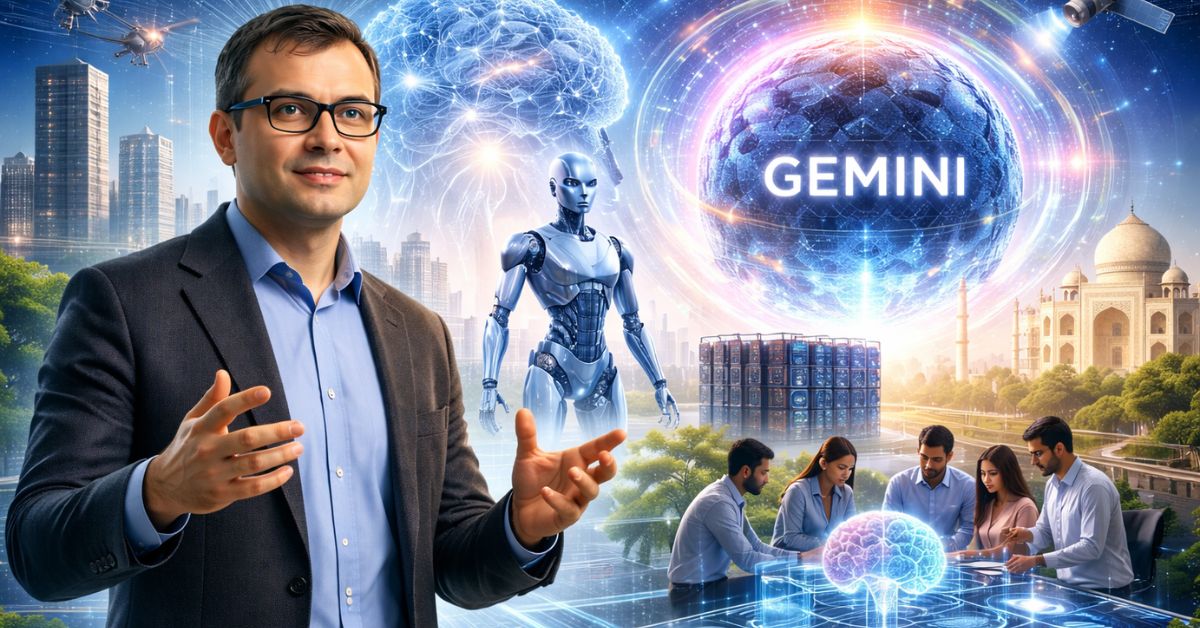
Artificial Intelligence is moving faster than anyone predicted. At the recent India AI Impact Summit 2026 in New Delhi, Google DeepMind CEO Demis Hassabis shared groundbreaking updates about the future of Google Gemini and the global race toward Artificial General Intelligence (AGI). His message was clear: we are standing at a threshold moment in human history, and India is positioned to be at the very center of it.
Here is a complete breakdown of what Hassabis revealed, the latest updates on Google’s AI models, and how these changes will impact technology, science, and everyday life in India.
What Happened: Demis Hassabis at the India AI Summit 2026
During his keynote address, Demis Hassabis surprised the tech world with a bold timeline. He predicted that true AGI—where a machine can match or exceed human reasoning across almost any task—could become a reality within the next five to eight years.
He explained that while today’s artificial intelligence tools are impressive, they are still limited. Hassabis described current AI as having a “jagged intelligence.” This means a model might be brilliant at solving complex math problems but completely fail at basic logical reasoning or long-term planning. The goal for Google DeepMind is to smooth out those jagged edges and create a system that can learn continuously from its environment, much like a human does.
Google Gemini’s Next Steps: Knowledge Meets Reasoning
To reach that next level of intelligence, Google is changing how it builds its AI models. Hassabis explained that the secret to reaching AGI is not just feeding a computer more data. Instead, it is about combining two different types of AI technologies.
First, there are foundation models like Google Gemini. These models have read vast amounts of the internet and act as a massive library of human knowledge. Second, there are reinforcement learning systems, similar to the technology that powered Google’s famous chess and Go-playing bots. These systems are excellent at planning ahead and solving problems through trial and error.
By layering advanced reasoning and planning skills on top of Gemini’s vast world knowledge, Google aims to create an AI that does not just answer questions, but actively thinks, plans, and solves entirely new problems on its own. Recent updates, such as Gemini Deep Think, are already proving this by solving advanced, PhD-level mathematical problems autonomously.
Why It Matters: Bigger Than the Industrial Revolution
The shift from simple chatbots to thinking AI agents is going to change the world permanently. Hassabis compared the coming AI revolution to the discovery of fire or electricity. He stated that AGI will likely have ten times the impact of the Industrial Revolution, but it will happen at ten times the speed. Instead of taking a century to change society, this transformation could unfold over a single decade.
However, Hassabis noted that AI is not just about building better business tools or writing emails. He sees artificial intelligence as the ultimate tool for scientific discovery. In the next ten years, AI is expected to usher in a new golden era of science, helping researchers cure diseases, discover new materials, and solve mysteries of physics that have puzzled humans for thousands of years.
The Impact in India: A New Global AI Powerhouse
One of the biggest takeaways from the summit was Google’s deep commitment to India. Hassabis called India a global powerhouse for artificial intelligence, noting the incredible talent and energy in the country’s research hubs.
To turn this potential into reality, Google DeepMind announced major partnerships across India. The company is collaborating with the Indian government and the Atal Tinkering Labs network to bring AI-powered learning tools to 10,000 schools, directly reaching over 11 million students. By using Gemini, static school textbooks will be transformed into interactive digital journeys where students can ask an AI assistant questions to deepen their understanding.
Furthermore, Google is partnering with Reliance Jio to ensure that Gemini’s foundation models are accessible to everyday users across India. With added support for multiple Indian languages and investments in local infrastructure, including new subsea internet cables and data centers, Google is ensuring that India is not just a consumer of AI, but a creator and leader in the space.
What Happens Next: Guardrails and Global Cooperation
While the future looks bright, Hassabis warned that the road ahead requires extreme caution. As AI systems become more autonomous, the risks of human misuse—such as cyber-attacks or the creation of biological threats—will increase.
Read More : Acer and Asus Banned in Germany
He urged the global community to treat AI development with the same rigor as traditional science. This means building strict safety guardrails, monitoring how the systems behave, and ensuring they do exactly what humans intend them to do. Hassabis emphasized that while engineers will eventually solve the technical challenges of AI, getting countries around the world to agree on how to govern and manage this power will be the hardest problem of all.
Frequently Asked Questions (FAQs)
What is AGI according to Demis Hassabis?
AGI stands for Artificial General Intelligence. Demis Hassabis defines it as a system that has all the cognitive capabilities that humans have, including creativity, problem-solving, and long-term planning.
When does Google expect AGI to be ready?
At the 2026 India AI Impact Summit, Hassabis predicted that AGI is on the horizon and could be achieved within the next five to eight years.
What did Demis Hassabis mean by “jagged intelligence”?
He used this term to describe current AI models. It means the AI is very good at some highly complex tasks but surprisingly bad at other simple tasks, making its overall intelligence uneven or “jagged.”
How is Google Gemini helping students in India?
Google is partnering with thousands of Indian schools and textbook publishers to integrate Gemini into classrooms. This allows students to use AI to get real-time help, understand complex subjects in local languages, and turn regular textbooks into interactive learning experiences.
What are the main risks of advanced AI?
Hassabis highlighted that the biggest short-term risks are bad actors using AI for cyber-security and bio-security threats. He stressed that international rules and safety guardrails are urgently needed before AI becomes fully autonomous.