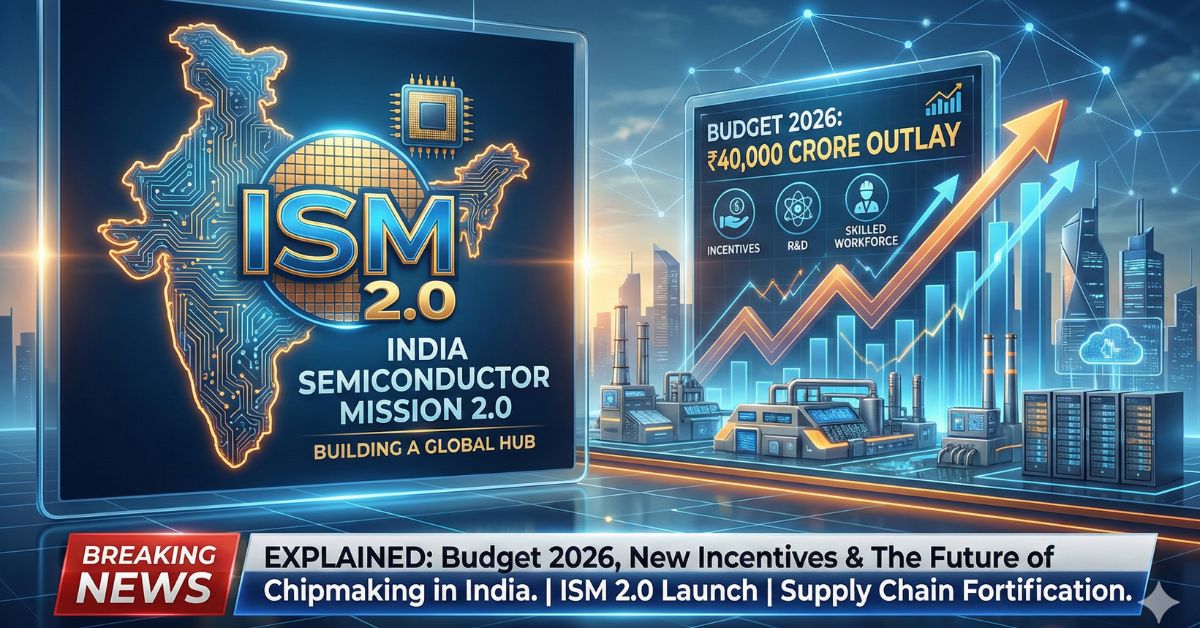
The Union Budget 2026-27 has officially launched the India Semiconductor Mission 2.0 (ISM 2.0), marking a massive shift in India’s technology strategy. While the first phase focused on setting up factories (fabs), this second phase aims to build the entire “brain and backbone” of the chip industry within India.
Finance Minister Nirmala Sitharaman announced the mission on February 1, 2026, with a fresh focus on producing raw materials, manufacturing equipment, and creating Indian Intellectual Property (IP).
This article breaks down exactly what ISM 2.0 is, how it differs from the first mission, and what it means for jobs and businesses in India.
What is India Semiconductor Mission 2.0?
India Semiconductor Mission 2.0 (ISM 2.0) is the next stage of the government’s plan to make India a global hub for electronics. The first mission (ISM 1.0) was about inviting big companies to set up chip factories. Now that companies like Tata and Micron are building plants, the government wants to ensure they have local supplies.
ISM 2.0 focuses on the supply chain. Instead of importing the machines and chemicals needed to make chips, India wants to manufacture them domestically.
Key Goals of ISM 2.0:
- Equipment Manufacturing: Making the complex machines that produce chips.
- Raw Materials: Producing specialized gases, chemicals, and substrates locally.
- Indian IP: Helping Indian startups design their own chips (Fabless design) rather than just manufacturing for others.
- Workforce: Setting up industry-led research centres to train engineers.
ISM 1.0 vs. ISM 2.0: What Changed?
Many people are asking how this is different from the ₹76,000 crore scheme announced in 2021. Here is the simple difference:
| Feature | ISM 1.0 (2021) | ISM 2.0 (2026) |
| Primary Focus | Setting up big factories (Fabs & ATMP units). | Building the supply chain (Tools, Materials, Design). |
| Goal | “Make in India” (Assembly & Manufacturing). | “Design & Own in India” (IP & Self-reliance). |
| Key Players | Big giants like Tata, Micron, CG Power. | Startups, chemical suppliers, and equipment makers. |
| Outcome | Reduced chip imports. | Complete independence in the chip ecosystem. |
Budget 2026 Allocations & Incentives
The government has backed this mission with serious funding in the 2026-27 Budget.
1. Direct Funding for ISM 2.0
An initial allocation of ₹1,000 crore has been set aside specifically for ISM 2.0 for the financial year 2026-27. This is just the kickstart fund, with the total outlay expected to grow as policies are finalized.
2. Boost for Component Manufacturing (ECMS)
The Finance Minister doubled the funding for the Electronics Components Manufacturing Scheme (ECMS) to ₹40,000 crore. This scheme incentivizes companies that make the smaller parts (capacitors, resistors, PCBs) that go into phones and laptops.
3. Modernizing SCL Mohali
A major highlight is the revival of the Semiconductor Laboratory (SCL) in Mohali. The government has planned a ₹4,500 crore modernization drive to turn this government-run lab into a world-class R&D centre.
- ₹900 crore has been released immediately for 2026-27.
- The goal is to increase production capacity by 100 times and create a high-tech training centre for students and researchers.
Why This Matters for India
Currently, even if India manufactures chips, it has to import the machines to make them from the Netherlands, USA, or Japan. It also imports the chemicals from other countries.
If a geopolitical crisis happens (like a war or pandemic), these supplies could stop, halting Indian factories. ISM 2.0 fixes this by ensuring the entire chain—from design to raw material to finished chip—exists within India.
Impact on Jobs:
This move will create high-value jobs. We are not just looking for factory workers; the demand will rise for:
- Chemical engineers (for materials).
- Mechanical design engineers (for equipment).
- VLSI design engineers (for chip design).
Current Status: Where Do We Stand?
As of February 2026, the progress is visible:
- 10 Major Projects Approved: This includes huge investments from Tata Electronics and Micron.
- Construction Speed: Plants in Gujarat and Assam are under construction, with some already reaching pilot production stages.
- Global Confidence: The “China+1” strategy is working, as global companies are actively looking to shift bases to India.
Conclusion
India Semiconductor Mission 2.0 is a mature step forward. It moves the country from “assembling” technology to “creating” it. By funding the supply chain and modernizing the SCL Mohali lab, the government is ensuring that India’s tech boom is permanent and self-reliant. The next few years will likely see the rise of Indian startups that don’t just use chips, but design the next generation of them.
Read More : Tech Progress vs Control
Frequently Asked Questions (FAQs)
Q1: What is the main aim of ISM 2.0?
The main aim is to build a local supply chain for semiconductors. This includes making chip-manufacturing equipment, raw materials (like chemicals and gases), and creating Indian chip designs (IP).
Q2: How much money is allocated for ISM 2.0 in Budget 2026?
The government has allocated an initial ₹1,000 crore for FY 2026-27 for ISM 2.0. Additionally, the component manufacturing scheme (ECMS) received ₹40,000 crore.
Q3: Will the Mohali Semiconductor Lab be privatized?
No. The government has clarified that the Semiconductor Laboratory (SCL) in Mohali will remain a government body. It is receiving ₹4,500 crore for modernization to become a top R&D and training centre.
Q4: How does this help Indian students?
It opens up high-tech career options. ISM 2.0 focuses heavily on “industry-led research,” meaning there will be more training centres and jobs for engineers in design, material science, and manufacturing.
Q5: When will the new incentives start?
The incentives were announced in the Budget on February 1, 2026. Detailed guidelines for applying to these new schemes are expected to be released by the Ministry of Electronics and IT (MeitY) within the next few months.