Kia Seltos EV (2026): Expected India Launch, Price, Range, Battery & Fast Charging, EV Features, Safety Tech, Variants, Colours & Booking/Availability Details
The SUV that changed Kia’s fortunes in India is finally ditching the tailpipe. While the second-generation 2026 Kia Seltos has just arrived with its petrol and diesel avatars, the real buzz in the “Electric Lane” is about the Kia Seltos EV. This isn’t just an experimental project; it is Kia’s high-voltage answer to the rising dominance of the Tata Curvv EV and the upcoming Hyundai Creta EV.
Set to debut by late 2026, the Seltos EV is expected to start at an aggressive ₹18.50 Lakh (Ex-showroom). It promises to carry forward the “Badass” design of the ICE (Internal Combustion Engine) Seltos while adding a silent, earth-shaking punch. The real truth is, Kia isn’t just selling a battery on wheels; they are selling a lifestyle upgrade. But with a market already crowded with long-range EVs, is it worth the premium price tag?
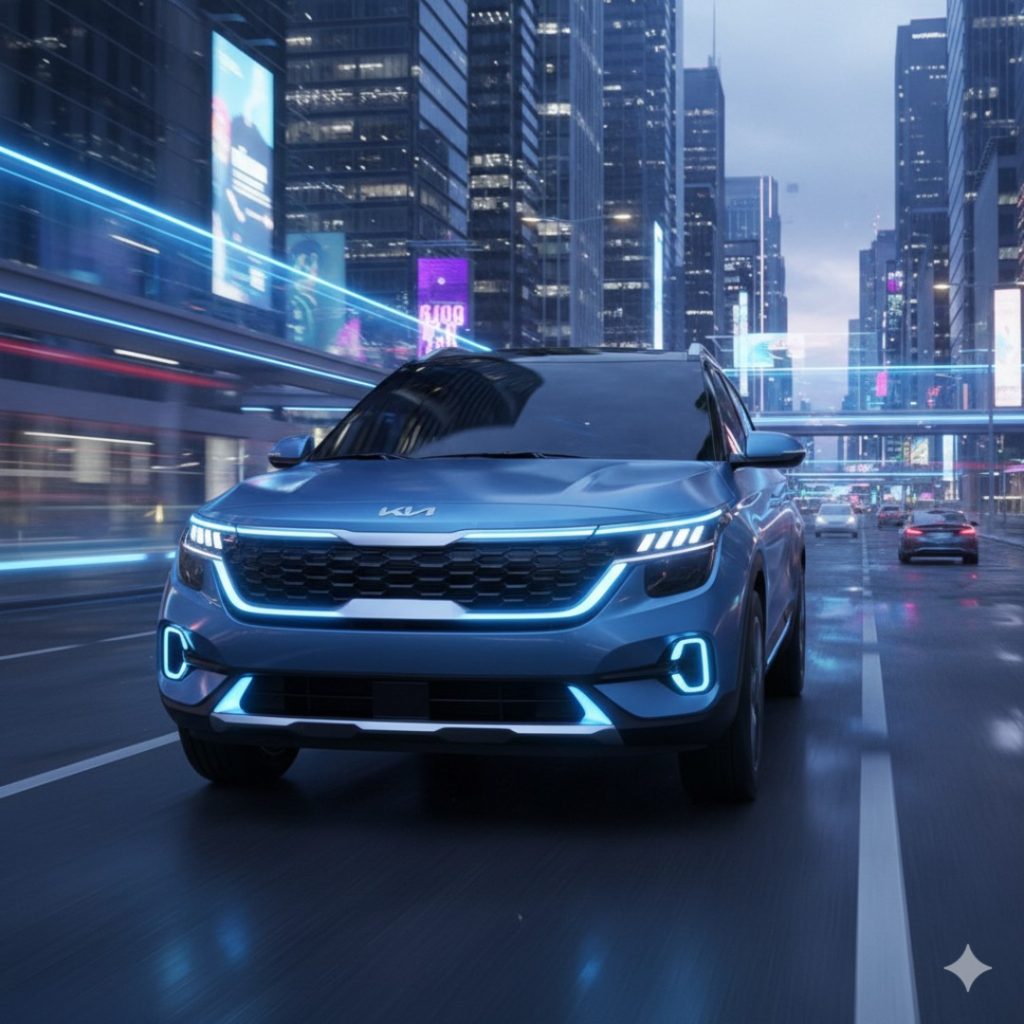
A futuristic, sleek front-angle shot of the Kia Seltos EV in an Electric Matte Blue color.
1. QUICK SPECS TABLE (Key Highlights)
Feature
Specification Details (Estimated)
Battery Pack
50 kWh – 60 kWh Lithium-Ion
Claimed Range
450 km – 500 km (ARAI/MIDC)
Power Output
150 BHP
Peak Torque
255 Nm (Instant)
Transmission
Single-speed Automatic
0-100 kmph
Under 9 Seconds
Ground Clearance
185 mm (Adjusted for Battery)
2. EXTERIOR DESIGN & ROAD PRESENCE
The Seltos EV takes the “Digital Tiger Face” from the 2026 facelift and makes it even more aerodynamic.
The Grille: Since there’s no radiator to cool, the grille is a solid, textured panel with hidden LED light patterns. It looks incredibly futuristic.
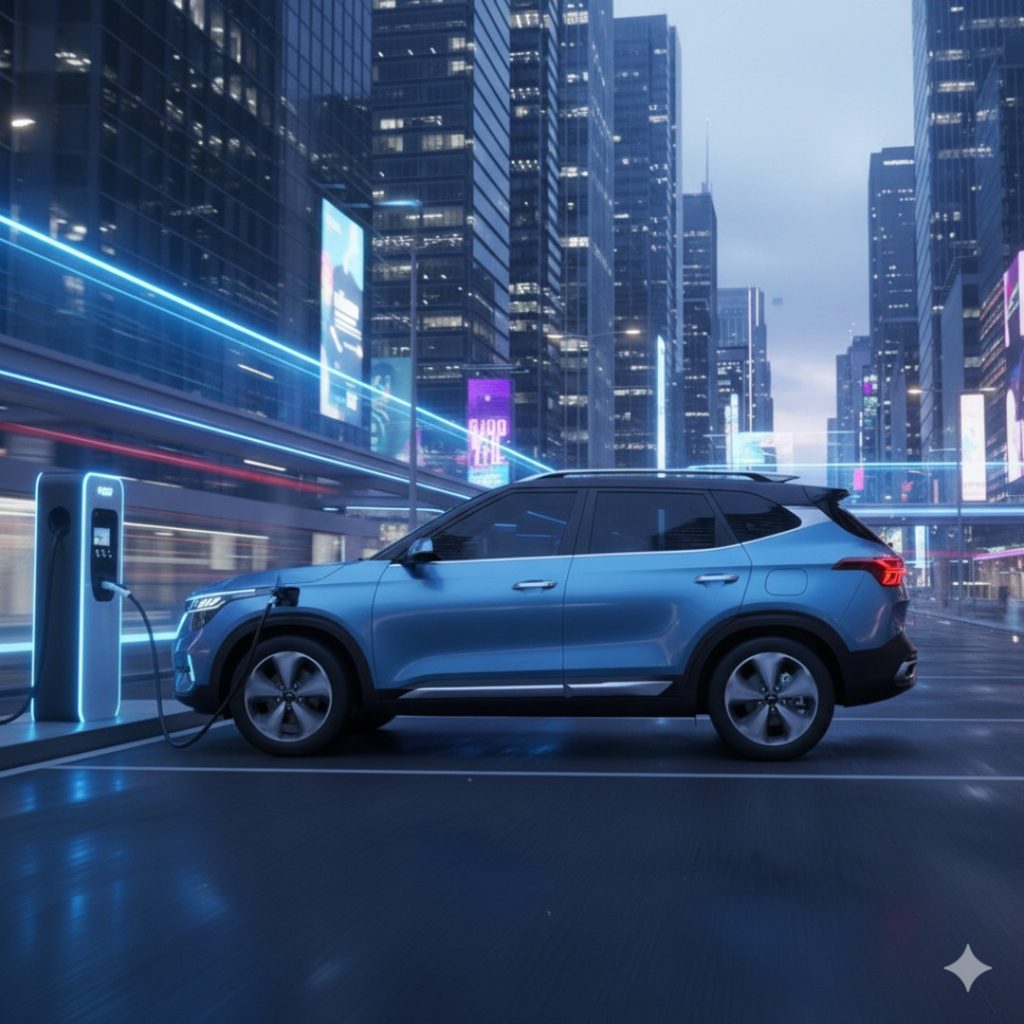
Aero-Alloys: It sits on 17-inch or 18-inch Crystal Cut Aero-Alloys designed specifically to reduce drag and squeeze out every extra kilometer of range.
Flush Door Handles: Borrowed from the EV6, the motorized flush door handles give the side profile a seamless, luxury-car look.
Road Presence: It feels more “techy” than “rugged.” The signature Star Map LED DRLs and the connected LED tail lamps make it look like a spaceship on Indian roads at night.
Side profile of the Kia Seltos EV parked near a modern DC fast-charging station.
3. INTERIOR, COMFORT & FEATURES
Inside, the Seltos EV feels significantly more premium than its petrol siblings, leaning heavily on the “Sustainable Luxury” theme.
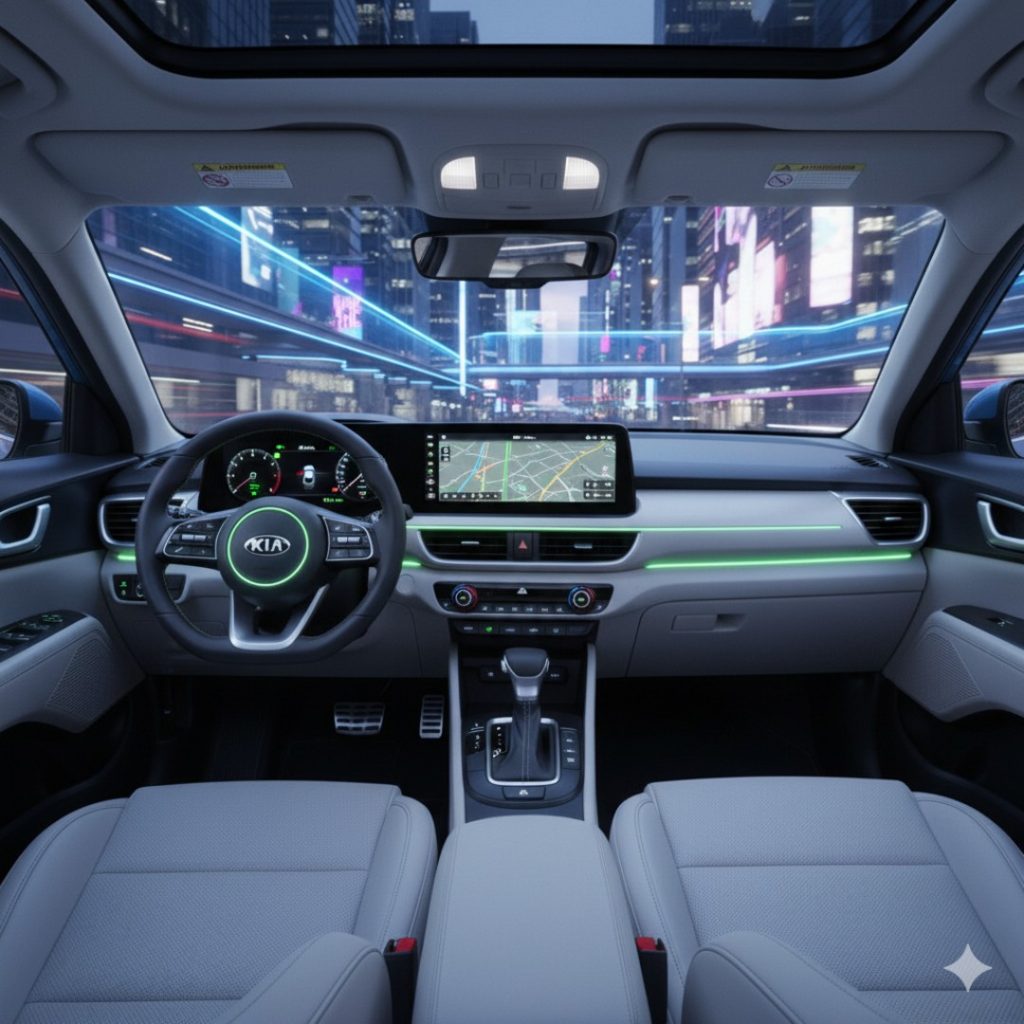
The Tri-Screen Setup: The dashboard is dominated by a massive curved display housing three screens: a 12.3-inch instrument cluster, a 5.3-inch climate display, and a 12.3-inch infotainment unit.
Space: Because of the new K3 platform, the wheelbase is longer, meaning the rear legroom is fantastic. However, can 3 people sit at the back? Comfortably, yes, as the floor is flat without the transmission tunnel hump found in the ICE version.
Key Features:
V2L (Vehicle-to-Load): You can plug in your laptop, coffee maker, or even charge another EV using the car’s battery.
Ventilated & Relaxation Seats: The driver gets a 10-way power-adjustable seat with memory function.
Missing Features: While it has almost everything, some might miss physical buttons for the infotainment, as most controls have moved to the touch panel.
Wide-angle interior shot of the Kia Seltos EV cockpit.
4. DRIVING DYNAMICS & PERFORMANCE
City Drive: This is where the Seltos EV will live. With 255 Nm of instant torque, the “stop-go” traffic in cities like Delhi or Mumbai becomes effortless. The i-Pedal (One-pedal driving) mode allows you to brake just by lifting your foot off the accelerator.
Highway Drive: It’s rock solid at 120 kmph. Unlike the petrol version, the weight of the batteries under the floor lowers the center of gravity, making it feel more “planted” around corners.
Suspension:The suspension absorbs potholes easily, though it feels slightly firmer than the standard Seltos to manage the extra 300 kg of battery weight.
5. SAFETY (The 5-Star Goal)
Kia is aiming for a full 5-star Bharat NCAP rating with the Seltos EV.
ADAS Level 2: Includes 21 autonomous features like Blind Spot Collision-Avoidance, Lane Keep Assist, and Smart Cruise Control with Stop & Go.
Battery Safety: The battery pack is IP67 rated (water and dust resistant) and features a reinforced casing for side-impact protection.
Standard Kit: 6 Airbags, ESC, Hill-Start Assist, and All-Wheel Disc Brakes are standard across all variants.
6. REAL WORLD RANGE (The Truth)
Don’t be fooled by the high “Claimed Range” numbers on the brochure.
ARAI/MIDC Claimed: 480 km
Real World City: Expect 350 – 380 km with moderate AC use.
Real World Highway: At speeds of 100 kmph, the range drops to roughly 280 – 310 km.
Charging: A 50kW DC Fast Charger will take you from 10% to 80% in about 45 minutes.
7. THE COMPETITION
Kia Seltos EV vs Hyundai Creta EV vs Tata Curvv EV
Feature
Kia Seltos EV
Hyundai Creta EV
Tata Curvv EV
Battery (Est.)
50-60 kWh
45-50 kWh
45-55 kWh
Real Range
~350 km
~320 km
~340 km
Vibe
High-Tech & Sharp
Sophisticated
Avant-Garde / Sporty
Price (Est.)
₹18.5 – 26 Lakh
₹18 – 25 Lakh
₹17.5 – 22 Lakh
The Winner: The Tata Curvv EV provides better value, but the Kia Seltos EV wins on interior tech, brand panache, and overall refinement.
Garima Thakur is the founder of Udaan eBike and an automobile/EV content writer. He shares simple, research-based insights on electric bikes, scooters, motorcycles, and cars to help Indian buyers choose the right vehicle with confidence.