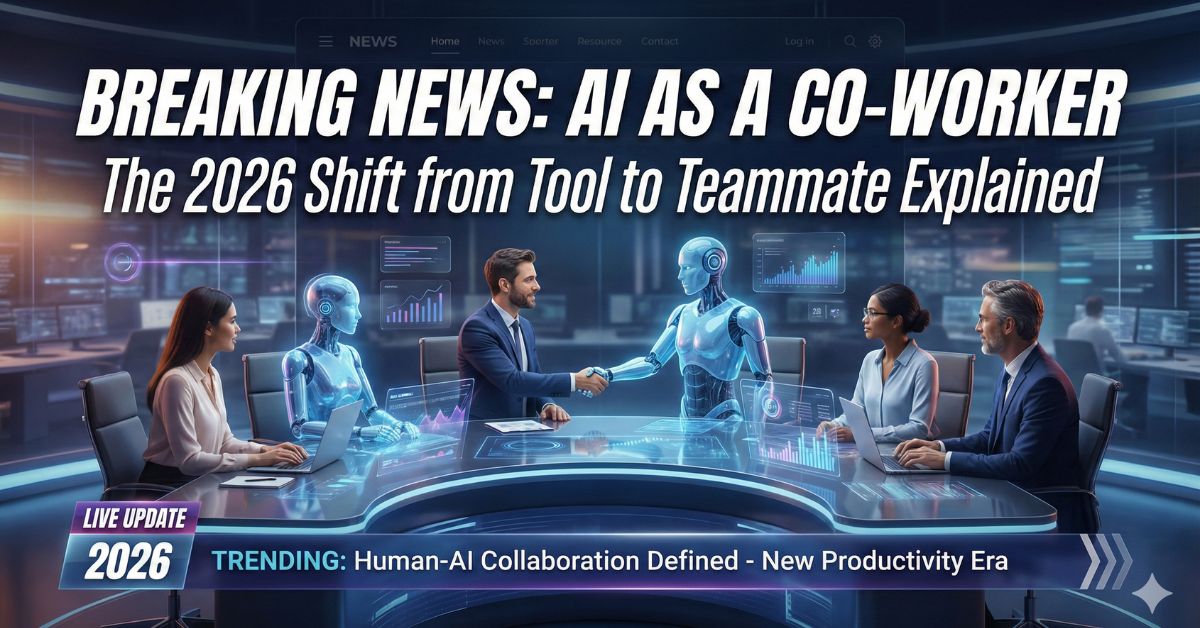
Imagine walking into your office (or logging in from home) and greeting your team. There is your manager, your designer, and… your AI agent. In 2026, Artificial Intelligence has stopped being just a sophisticated calculator or a chatbot you occasionally ask for help. It has evolved into a fully functional “digital co-worker” that works alongside you.
For years, we treated AI like a tool—something we pick up to write an email or fix code, and then put down. But 2026 marks the era of “Agentic AI.” These are not passive software programs waiting for instructions. They are active teammates that can take responsibility, make decisions, and complete complex projects on their own.
This shift is transforming workplaces across India, from IT hubs in Bangalore to manufacturing units in Gujarat. Here is what you need to know about your new digital colleague.
From “Chatbot” to “Co-Worker”: What Changed?
The biggest difference in 2026 is autonomy.
- In 2024/25 (The Copilot Era): You had to guide the AI step-by-step. You would say, “Write this email,” then “Check for errors,” then “Send it.” You were the driver; AI was the passenger.
- In 2026 (The Agent Era): You give the AI an outcome, not just a task. You might say, “Coordinate with the supplier to fix the delay and update the inventory.” The AI agent then emails the supplier, negotiates a time, updates your database, and informs your team—all without you clicking a button.
Industry experts call this “Connected Intelligence.” It is no longer just humans talking to AI; it is AI agents talking to other AI agents to get work done.
The Impact on Indian Workplaces
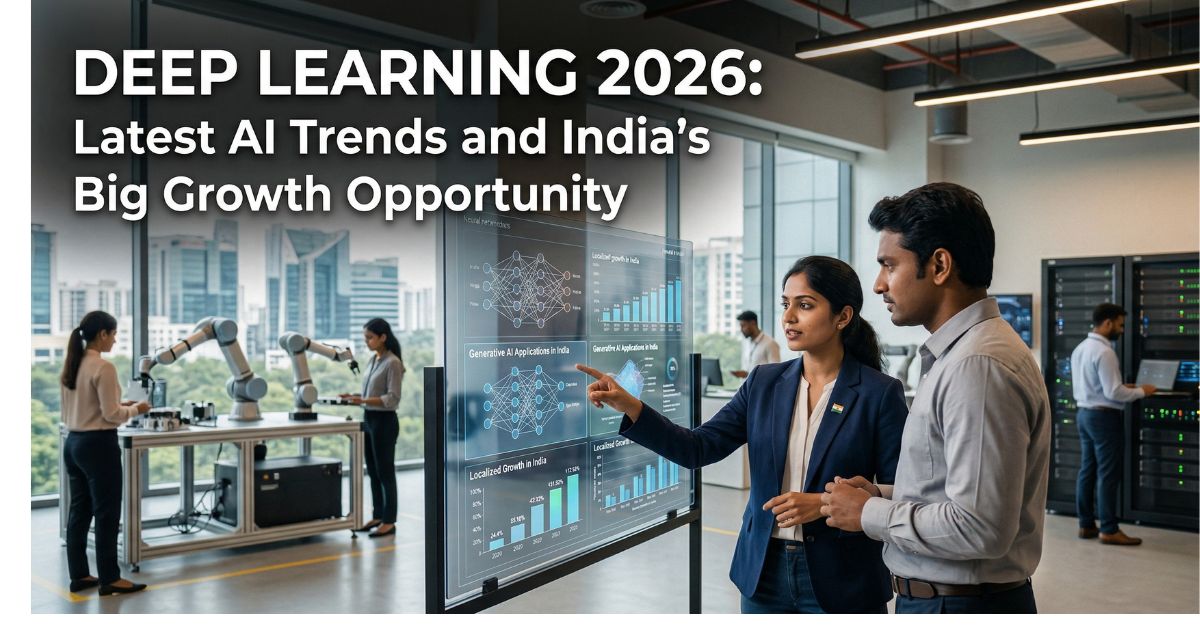
India is adopting this shift faster than many expected. With the India AI Impact Summit taking place in New Delhi in February 2026, the country is focusing on “real-world” AI applications rather than just hype.
1. The IT and Tech Sector
For Indian software developers, the days of writing basic code are gone. AI agents now handle the bulk of coding, testing, and debugging. The human role has shifted to “System Architecture” and “Context Engineering.” Developers now manage a team of AI agents, ensuring they are building the right product securely.
2. Vernacular and Local Business
A major trend in 2026 is India-specific AI. We are seeing AI co-workers that speak Hindi, Tamil, Bengali, and other regional languages fluently. In sectors like agriculture or cooperative banking, these agents help officers process loans or analyze crop data by speaking directly to farmers in their local dialect.
3. HR and Recruitment
Human Resources departments are using “digital recruiters.” These agents don’t just scan resumes; they conduct initial interviews, answer candidate questions 24/7, and schedule meetings. However, the final hiring decision remains strictly with humans to ensure fairness.
New Skills: How to Manage Your AI Teammate
If AI does the work, what do humans do? The fear of job replacement is real, but the reality is job evolution. In 2026, the most valuable skill is not just “prompt engineering,” but “Agent Management.”
- Delegation: You need to know which tasks to give to an AI and which require a human touch.
- Review and Ethics: An AI co-worker can work fast, but it can also make fast mistakes. Humans act as the “quality control” managers, checking for bias or errors.
- Strategy: AI is great at execution (doing things), but humans are still needed for strategy (deciding what to do).
The Risks: Burnout and “Agent Washing”
This new era is not without challenges.
- Mental Fatigue: Because AI handles all the “easy” work, humans are left with only the hard, complex problems. This constant cognitive load is leading to higher burnout rates among professionals.
- Privacy Concerns: With AI agents accessing emails, calendars, and sensitive files to do their jobs, data security is a massive concern. Companies are spending heavily to ensure their “digital employees” don’t accidentally leak secrets.
- “Agent Washing”: Many software companies claim to have “autonomous agents,” but they are actually just old chatbots repackaged. Businesses are learning to spot the difference.
What Happens Next?
The future is the Hybrid Team. We will not see offices run entirely by robots, nor will we go back to the old way of working. The most successful professionals in India will be those who treat AI not as a threat, but as a junior colleague who is super smart, very fast, but needs guidance.
Read More : Latest Tech Updates 2026
As we move deeper into 2026, the question is no longer “How do I use this tool?” but “How do I lead this team?”
Frequently Asked Questions (FAQ)
Q1: Will AI co-workers replace my job in 2026?
For most professionals, AI will not replace you, but a person using AI might. The role is shifting from “doing the task” to “managing the AI that does the task.” Routine jobs are at higher risk, while roles requiring judgment and empathy are safe.
Q2: What is the difference between a Copilot and an Agent?
A Copilot waits for you to tell it exactly what to do (like a smart pen). An Agent can take a goal (like “plan a meeting”) and do all the necessary steps (emailing, checking calendars, booking rooms) on its own.
Q3: Is it safe to let AI agents access my work files?
Security is the top priority in 2026. Companies use “Zero Trust” security models, meaning the AI is given access only to the specific files it needs for a task, and every action is recorded.
Q4: Do I need to learn coding to work with AI agents?
No. In 2026, most AI agents interact in plain English (or Indian languages). You need good communication and logic skills, not necessarily programming code.
Q5: Are these AI agents expensive for small businesses?
Initially, yes.