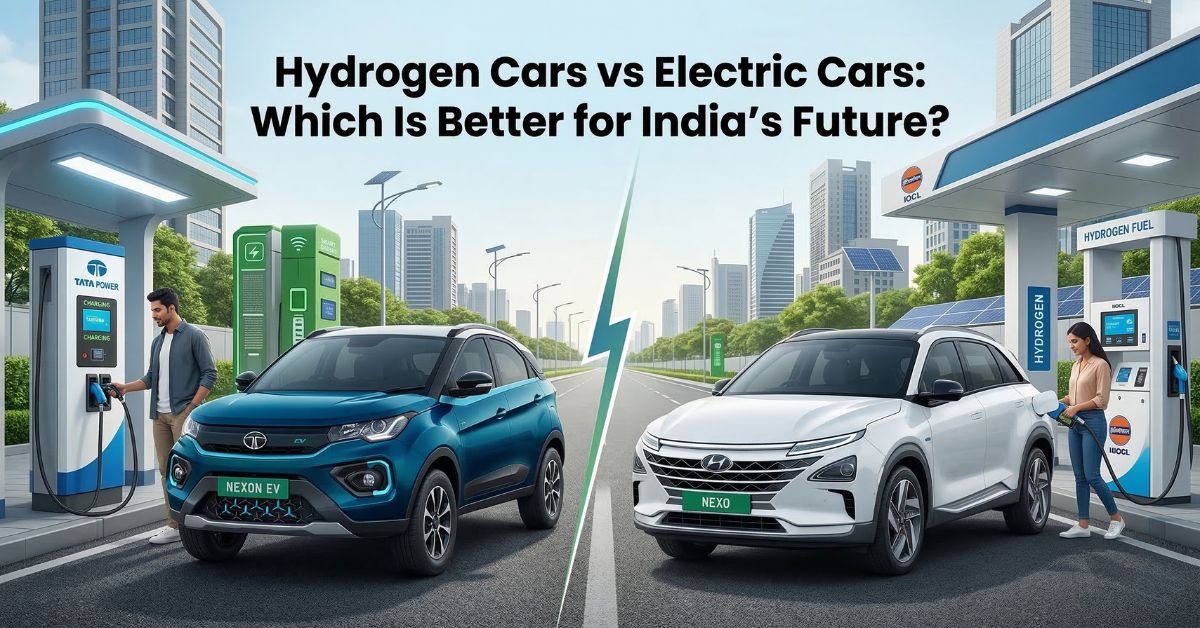
The global auto industry is moving quickly toward clean mobility. Petrol and diesel vehicles are slowly being replaced by new technologies that produce little or no emissions. Among these, Hydrogen Cars vs Electric Cars are often seen as the two main options for the future.
But many people in India still ask a simple question: Which is better — hydrogen cars or electric cars? Both technologies promise cleaner transport, but they work differently and face different challenges.
This article explains the key differences between hydrogen cars and electric cars, their advantages, costs, infrastructure needs, and what the future may look like in India.
What Are Electric Cars? (Hydrogen Cars vs Electric Cars)
Electric cars, also called Battery Electric Vehicles (BEVs), run completely on electricity stored in rechargeable batteries. The battery powers an electric motor that drives the wheels.
Instead of filling fuel at a petrol pump, an electric car is charged using electricity from a home charger or public charging station.
Electric vehicles are already widely available in India, with many models from companies like Tata, MG, Hyundai, and Mahindra. Their popularity is increasing due to government incentives and lower running costs.
Electric vehicles produce zero tailpipe emissions, which makes them cleaner than traditional petrol or diesel cars.
What Are Hydrogen Cars? (Hydrogen Cars vs Electric Cars)
Hydrogen Cars vs Electric Cars cars are also electric vehicles, but they work differently. These vehicles use a hydrogen fuel cell instead of a large battery.
Inside the fuel cell, hydrogen reacts with oxygen to generate electricity. This electricity then powers the motor. The only by-product released from the exhaust is water vapor.
In simple terms, hydrogen cars generate their own electricity while driving, whereas electric cars store electricity in batteries.
Hydrogen cars are still rare globally. Only a few models exist, such as the Toyota Mirai and Hyundai Nexo.
Key Differences Between Hydrogen Cars vs Electric Cars
1. Fueling and Charging
One major difference is how the vehicles are powered.
Electric cars need charging stations. Charging can take anywhere from 30 minutes with fast chargers to several hours at home.
Hydrogen Cars vs Electric cars are refueled at hydrogen stations, similar to petrol pumps. Refueling usually takes just a few minutes, which is much faster than charging an EV.
However, hydrogen refueling stations are extremely limited worldwide and almost nonexistent in India.
2. Driving Range
Hydrogen cars generally offer a longer range than many electric vehicles.
Some hydrogen cars can travel 400–600 miles on a full tank, while electric vehicles typically range between 150–375 miles depending on battery size.
That said, EV battery technology is improving rapidly, and many new models now provide long driving ranges.
3. Efficiency
Electric cars are much more energy-efficient.
Battery electric vehicles convert a larger portion of energy into movement, while hydrogen vehicles lose energy during hydrogen production, compression, and conversion into electricity.
Because of this efficiency advantage, EVs currently consume less energy per kilometre than hydrogen vehicles.
4. Cost of Vehicles
Electric cars are usually cheaper to buy compared to hydrogen cars.
Fuel-cell systems are complex and expensive to produce, which makes hydrogen vehicles costly. For example, the hydrogen-powered Toyota Mirai is expected to cost around ₹60 lakh in India.
In contrast, electric cars are available across many price ranges and have become more affordable as battery costs fall.
5. Running Cost
Electric cars generally have the lowest running cost.
Studies show that electricity can cost around ₹0.80 per kilometre, while hydrogen fuel can cost around ₹4 per kilometre in current conditions.
This makes EVs much cheaper for daily driving in India.
6. Infrastructure Availability
Infrastructure is a major factor.
India already has thousands of EV charging stations and the number is increasing quickly. On the other hand, hydrogen refueling stations are still very limited globally.
Because of this, electric vehicles are currently more practical for everyday use.
Hydrogen Cars vs Electric Cars: Environmental Impact
Both hydrogen and electric vehicles produce zero tailpipe emissions, which helps reduce air pollution.
However, the environmental impact depends on how the energy is produced.
If hydrogen is produced using renewable energy (green hydrogen), it can be very clean. But today, most hydrogen is produced using fossil fuels, which reduces its environmental advantage.
Electric vehicles also depend on electricity sources, but even on the current power grid they can produce 30–40% lower emissions than petrol cars in lifecycle terms.
The Current Situation in India
India is currently focusing more on electric vehicles.
Government schemes like FAME and other EV incentives are encouraging electric mobility. Charging infrastructure is expanding across major cities.
At the same time, India is investing in green hydrogen technology. Pilot projects have already begun to test hydrogen-powered trucks and buses on select routes.
This means hydrogen vehicles may become important in the future, especially for heavy transport.
Why Electric Cars Are Leading Today
Several reasons explain why EVs are growing faster than hydrogen vehicles:
- Lower vehicle cost
- Lower running cost
- Better efficiency
- Rapidly expanding charging network
- Government incentives
Experts say battery electric vehicles are currently cheaper and require less new infrastructure compared to hydrogen vehicles.
What the Future May Look Like
Many experts believe both technologies may coexist.
Electric cars are likely to dominate personal vehicles and city transport.
Hydrogen vehicles could become useful for trucks, buses, ships, and long-distance transport, where fast refueling and long range are important.
India is also investing in green hydrogen production, which could reduce hydrogen costs in the future.
Conclusion
The debate between hydrogen cars and electric cars is not about which technology is perfect. It is about which one works best in different situations.
Right now, electric cars are clearly ahead in India because they are cheaper, more efficient, and supported by growing infrastructure.
Read More : Big Update: AI in Cars Explained 2030
Hydrogen Cars vs Electric Cars vehicles, however, may play a big role in the future, especially for heavy transportation and long-distance travel.
As technology improves and green energy expands, both options could help India move toward a cleaner and more sustainable transport system.(Hydrogen Cars vs Electric Cars)
FAQs(Hydrogen Cars vs Electric Cars)
1. Which is better, hydrogen cars or electric cars?
Currently, electric cars are more practical because they are cheaper, more efficient, and supported by better infrastructure.
2. Are hydrogen cars available in India?
Hydrogen cars are not widely available yet. They are still in the testing and pilot stage in India.
3. Do hydrogen cars produce pollution?
No. Hydrogen cars release only water vapor from the exhaust.
4. Why are electric cars more popular than hydrogen cars?
Electric cars are more popular because they are cheaper, easier to charge, and have many models available.
5. Will hydrogen cars replace electric cars?
Experts believe hydrogen cars will not replace EVs but may complement them, especially in heavy transport sectors.