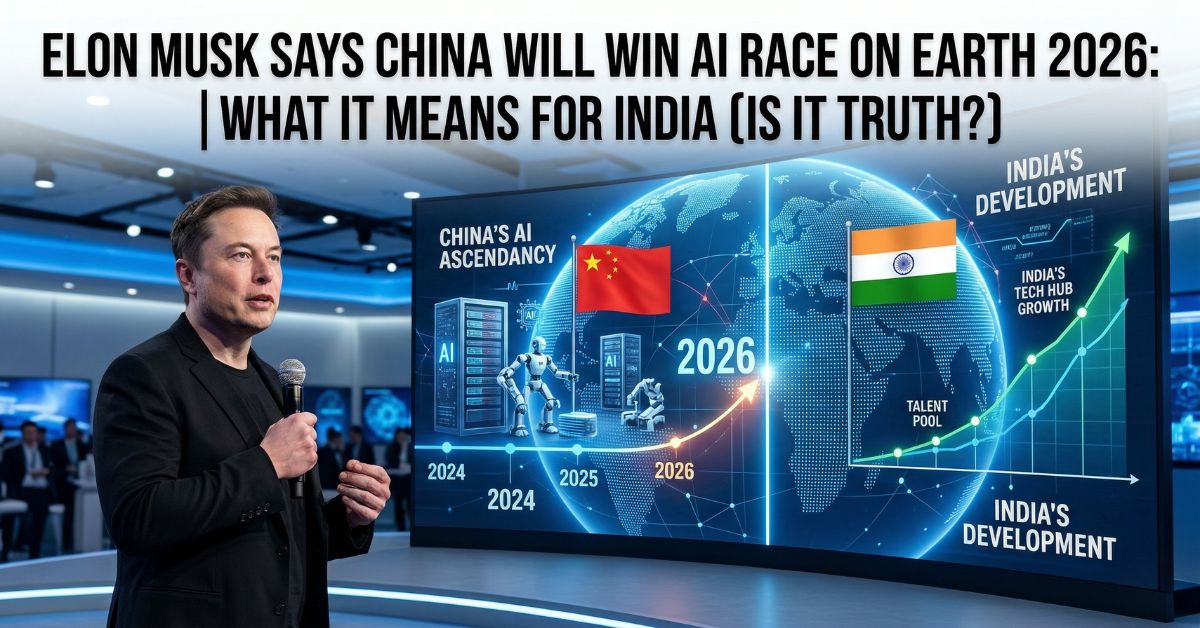
Elon Musk Says China Will Win AI Race on Earth 2026 has sparked a fresh debate in the tech world after saying that China could win the AI race on Earth, while SpaceX could lead in space. His remark came during an online exchange about the future of artificial intelligence and quickly became a major talking point across tech media. For readers in India, this story is not just about one bold statement. It also raises a bigger question: where does India stand in the fast-changing global AI race?
What Elon Musk Said
According to multiple Indian news reports covering Elon Musk Says China Will Win AI Race on Earth 2026 post, he said that Google would win the AI race in the West, China would win on Earth, and SpaceX would win in space. The comment was made in response to a discussion around Google’s Gemini models and competition in AI. The wording drew attention because Musk did not present xAI as the overall leader on Earth, and instead pointed to China as the strongest force in the wider global contest.
This was widely read as a geopolitical statement as much as a technology one. It suggests that Musk sees China’s scale, state support, industrial capacity, and speed of execution as major advantages in artificial intelligence. That view also fits with wider reporting that China is putting AI, robotics, and space technology at the center of its new 2026–2030 policy plans.
Why This Comment Matters
Musk’s statement matters because he is not speaking from the sidelines. He is deeply involved in AI through xAI, Tesla’s self-driving and robotics work, and SpaceX’s ambitions in space-based computing. Reuters reported on March 19, 2026 that Tesla is working toward its next-generation AI6 chips, which are expected to support self-driving vehicles and humanoid robots. Reuters also reported earlier this year that Musk is pushing the idea of space-based AI data centres through SpaceX-linked plans.
So when Musk says China may win the AI race on Earth, the market takes it seriously. It signals that even top American tech leaders believe the competition is no longer only about Silicon Valley labs. It is also about manufacturing scale, energy access, chips, public policy, data, and long-term national strategy.
The Bigger Background: Why China Is Seen as Strong in AI
China’s position in AI has been strengthening because of a mix of policy backing and industrial planning. Reuters reported in early March that China was set to use its National People’s Congress and the 15th Five-Year Plan for 2026–2030 to push the next stage of its technology race with the West, with AI, humanoid robots, and space among the expected priority areas.
There is also a growing view that AI leadership will depend on who can combine research with large-scale deployment. China’s advantage is often seen in fast implementation, large domestic platforms, hardware ecosystem depth, and strong state coordination. Reuters also noted that China is planning space-based AI infrastructure over the next five years, showing that the competition is expanding beyond chatbots and into computing power itself.
What Top News Coverage Is Focusing On
Top-ranking India-focused coverage on this topic has mostly followed a clear search intent: readers want to know exactly what Musk said, why he said it, and what it means for the global AI race. The main headlines from India Today, Mint, NDTV, and Times of India all frame the story around Musk’s prediction and the winners he named in the West, on Earth, and in space. Their structure is largely similar: first the quote, then the social media context, then broader AI rivalry and Musk’s companies.
That tells us the strongest content angle is not just the quote itself. Readers also want context. They want to understand whether this was a casual comment, a serious warning, or a realistic assessment of where AI power is moving.
What This Means for India
For Elon Musk Says China Will Win AI Race on Earth 2026 remark is a reminder that the AI race is now global and fast-moving. India is trying to build its own path instead of copying either the US or China. The government says the IndiaAI Mission, launched in March 2024, is meant to expand access to compute, support innovation, and promote AI solutions built for India-specific needs. A PIB release published on March 13, 2026 said indigenous foundation model efforts are underway, 12 teams have been shortlisted in phase 1, and models from Sarvam AI, BharatGen, Gnani, and Socket were launched during the IndiaAI Impact Summit 2026.
India has also put strong public focus on Elon Musk Says China Will Win AI Race on Earth 2026 infrastructure. Another official release said the IndiaAI Mission has a budget of more than ₹10,300 crore over five years, and that 38,000-plus high-end GPUs had been made available at ₹65 per hour to lower the cost barrier for startups, researchers, students, and public institutions.
This matters because AI leadership is not decided only by talent. It also depends on affordable compute, data access, local-language models, strong research pipelines, and commercial adoption. India has clear strengths in software talent, digital public infrastructure, and a massive user base, but it still has work to do in chips, large-scale model training, and faster product deployment. Reuters recently described India as racing to build AI capacity while also balancing economic opportunity and policy concerns.
Why Indian Readers Should Watch This Closely
The impact on India could be significant in several ways. First, global Elon Musk Says China Will Win AI Race on Earth 2026 competition will shape where investment flows, which companies expand fastest, and how much access Indian startups get to advanced chips and cloud infrastructure. Second, if China keeps moving quickly and the US tech giants remain dominant in the West, India may face pressure to scale its own AI ecosystem much faster. Third, sectors like education, healthcare, agriculture, coding tools, customer support, and manufacturing in India will all be influenced by how global AI platforms evolve.
There is also a jobs angle. Reuters noted that India sees AI as a major economic opportunity, but also faces concerns over employment disruption, especially in service-heavy sectors. That means India’s AI push has to balance growth with skilling, safeguards, and real-world usefulness.
Is Musk’s Prediction Final or Just One View?
No single comment can settle who will win the AI race. Musk’s statement is important, but it is still an opinion, not an official ranking. The AI race is also not one race. Different players may lead in different layers, such as chips, consumer AI tools, robotics, cloud infrastructure, military use, or space-based computing. Even Musk’s own comment divided the future into three parts: the West, Earth, and space.
What is clear is that China is being taken seriously by top global tech figures, and India can no longer treat AI as a side story. It is becoming central to growth, national capability, and global influence.
What Happens Next
The next stage of this story will depend less on social media posts and more on execution. Elon Musk Says China Will Win AI Race on Earth 2026 is moving ahead with long-term AI and tech planning. Musk’s companies are pushing chips, robotics, and space computing. India is building its own public-backed AI infrastructure and local model ecosystem. Over the next year, the key signals to watch will be compute expansion, chip access, sovereign model progress, local-language AI adoption, and policy support.
Read More : Humanoid Robots in 2026: Best Technology, Companies and What It Means for the Future !
For India, the message is simple: the AI race is no longer future talk. It is already shaping markets, policy, technology, and jobs right now.
FAQs(Elon Musk Says China Will Win AI Race on Earth 2026)
Did Elon Musk really say China will win the AI race on Earth?
Yes. Multiple India-focused reports said Musk wrote that Google would win in the West, China would win on Earth, and SpaceX would win in space.
Why is Musk saying China is ahead?
His comment appears to reflect China’s growing strength in AI, manufacturing, industrial policy, and long-term tech planning. Reuters has also reported that China is putting AI, robotics, and space technology at the center of its new development strategy.
How does this affect India?
It puts more pressure on India to scale AI infrastructure, local models, and affordable compute. India has already launched the IndiaAI Mission and is building domestic AI capacity, but the global race is moving fast.
Is India behind in AI?
India has strong talent and a large digital market, but it is still catching up in areas like large-scale compute, chips, and foundational model development. At the same time, the government and startups are moving quickly to strengthen India’s position.
What official steps has India taken in AI?
The government says the IndiaAI Mission was launched in March 2024, supports India-specific AI solutions, and is expanding access to GPUs and indigenous AI models.
Could the AI race also move into space?
Yes. Reuters reported that Musk is pursuing space-based AI data centre ideas and that China is also planning space-based AI infrastructure.