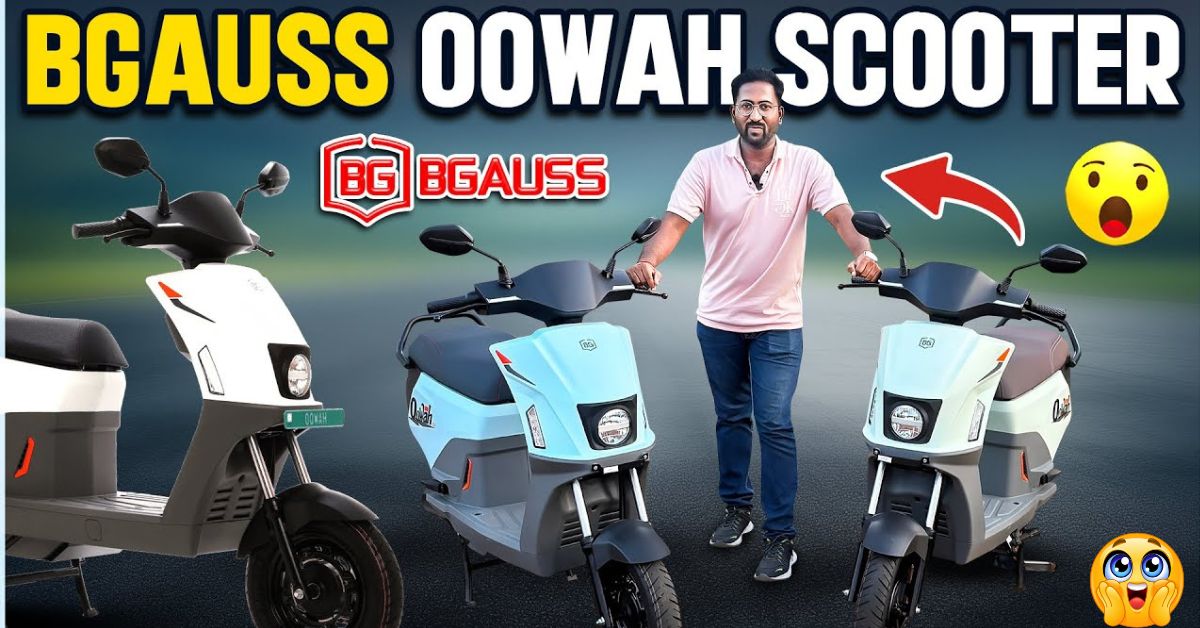
The BGauss OoWah represents one of the most talked-about modern electric scooters available in India — blending affordability, practicality, efficiency and convenience into a compact, city-ready package. For buyers looking to switch from petrol two-wheelers to an EV for daily commutes or short urban rides, OoWah offers a compelling value proposition. In this updated guide for 2025, we explore everything you need to know about the scooter: its pricing in India, battery and range capabilities, performance metrics, technical specifications, real-world usability, and whether it makes sense as a daily ride in Indian conditions.
What Is BGauss OoWah and Who Is It For
BGauss launched the OoWah as an entry-level electric scooter aimed at users who prioritise cost-effectiveness, ease of maintenance, and clean mobility over high-speed performance. The scooter is designed to be lightweight, simple to operate, and practical for urban commuting — a segment increasingly relevant given rising fuel costs and city pollution. The idea is not to build a powerful performance scooter, but a no-frills, efficient, and reasonably capable two-wheeler for everyday use: commuting to work or college, city errands, short-to-medium distance rides, or as a second household vehicle.
With its modest top speed and a decent claimed range, the OoWah attempts to strike a balance: enough power to handle typical city traffic, stable enough for short highway stretches (within legal/regulation limits), and affordable enough for budget-conscious buyers. For those seeking a reliable EV for routine use rather than speed or sporty performance, the BGauss OoWah offers good real-world practicality.
Price & Variants in 2025
As of 2025, the BGauss OoWah is priced at ₹ 94,990 (ex-showroom) in most Indian cities.
Depending on city taxes, registration, insurance and other charges, the on-road price may vary; for example, in Chennai the on-road price of the base variant has been reported around ₹ 1.02 lakh.
The scooter is offered in (at least) two variants, commonly referred to as “EX” (base) and “MAX” (higher spec / possibly with larger battery or enhanced features), giving buyers the option to choose depending on their budget and usage needs.
Colour options typically include Sage Green, Laguna Blue and Cloud White.
Given its price and positioning, OoWah aims to deliver a full-EV ownership experience at a budget-friendly level — making it an attractive option for first-time EV buyers, students, urban commuters, or those seeking a second scooter for local use.
Electric Powertrain, Battery & Charging Details
The BGauss OoWah is powered by a PMSM (Permanent Magnet Synchronous Motor) hub motor. The continuous power output is rated at around 1.5 kW, with a peak motor output of 2.4 kW to help during acceleration and load conditions.
Battery capacity is typically 2.3 kWh in the standard configuration (and in some spec sheets, 3.0 kWh is also mentioned depending on variant) — this is a removable lithium-ion battery, making home charging convenient.
Charging from 0–100% typically takes around 5.15 hours using the standard onboard charger. For a faster turnaround, from 0–80% charge takes around 4 hours 5 minutes with the stock charger.
This charging profile makes OoWah suitable for overnight plugging at home or work. For many users with daily commutes under 25–30 km (one way), charging every 3–4 days might be enough, depending on usage pattern — making it a practical EV substitute in urban scenarios.
Range, Performance, and Riding Capabilities
BGauss advertises a claimed range of up to 145 km on a single charge under ideal riding conditions.
Independent and user-reported real-world range tends to be lower, often around 100–110 km per full charge with mixed city usage and moderate riding style — a common expectation for most electric scooters under real-world conditions.
Top speed is limited to 60 km/h, which aligns with typical electric scooter regulations in India and makes the OoWah suitable for city traffic and moderate-speed roads, rather than high-speed highways.
Acceleration is tuned for practicality rather than performance. The hub motor ensures adequate low-speed torque to handle stop-and-go city traffic and pillion loads reasonably well, though it is not meant for aggressive riding or high-speed runs.
Given its performance envelope, the OoWah is ideal for urban commuting, short to moderate inter-city rides on state highways (within top-speed limits), and everyday errands. It is not designed to compete with high-speed electric motorcycles or high-performance scooters, but rather to offer reliable, efficient, and low-maintenance urban mobility.
Build, Dimensions, Ride Comfort & Usability
The BGauss OoWah features a lightweight chassis and compact dimensions aimed at urban maneuverability. Reported kerb weight is around 97 kg in standard variant configuration (although some sources mention weights up to 104 kg depending on battery and configuration).
The scooter rides on tubeless tyres fitted on steel wheels, which adds to durability and reduces maintenance burden compared to alloy wheels or premium tyres — a trade-off aimed at cost-effectiveness and robustness for everyday commuting.
Braking is handled via drum brakes on both front and rear wheels, coupled with a Combi Brake System (CBS) to help distribute braking force — a pragmatic choice considering its modest top speed and urban usage focus.
Ground clearance is around 160 mm, which gives a buffer over typical Indian road irregularities and speed breakers — another plus for city and semi-urban riding conditions.
The scooter’s ergonomics are designed to be user-friendly. Seating posture is upright and comfortable, suitable for daily commuting, short rides and errands. Removable battery, modest weight, and manageable dimensions make it easy even for riders switching from smaller petrol scooters or mopeds. For new EV adopters or riders wary of handling heavy electric scooters, OoWah offers a relatively accessible entry point.
Read More: Harley-Davidson Sportster S
Real-World Suitability, Strengths and Limitations
For an average city or suburban rider, the BGauss OoWah presents several strengths: it is affordable compared to many other electric scooters, offers reasonable range per charge, handles daily commuting and short trips effectively, and reduces running costs compared to fuel-based scooters. The removable battery enables convenient home charging, avoiding dependency on external charging infrastructure.
OoWah’s low maintenance needs (no fuel, fewer moving parts, no clutch/gearbox, minimal oil servicing) make it especially attractive for users prioritizing convenience. For students, office-goers, delivery riders on light routes, or second-vehicle owners, it can serve as a highly efficient daily commuter.
However, there are trade-offs. The top speed of 60 km/h limits its usability on high-speed highways, and long-distance touring is not practical. Drum brakes and modest suspension are acceptable for city use but may feel underpowered under heavier loads or with pillion rides. The real-world range, though decent, depends heavily on load, speed, terrain and battery health — so daily riders should gauge realistically, not purely on manufacturer claims. Removable battery charging means frequent cycles — users should plan charging cycles carefully to avoid being stranded mid-route.
Overall, the OoWah excels in scenarios it was built for: urban commuting, short-range usage, ease of handling and low-cost operation. For riders seeking performance, long range or highway comfort — it may fall short. But as a budget-friendly, practical electric scooter, it remains a strong contender.
2025 Expert Verdict: Is BGauss OoWah Worth Buying?
In 2025, the BGauss OoWah stands out as one of the most sensible, balanced, and value-for-money electric scooters in India’s growing EV market. Its combination of affordable pricing, decent real-world range, practical top speed for city use, manageable weight and low maintenance make it an excellent choice for urban commuters, students, working professionals, or anyone looking for an easy-to-use electric two-wheeler.
If your typical usage pattern involves daily commuting within city limits or short to mid-range travel, and if you value convenience, low running costs and environmental friendliness over high speed or sporty performance — OoWah delivers exactly that. The modest downsides are a reasonable trade-off for what it provides: clean mobility, silent rides, low maintenance and cost savings over time.
For riders seeking a simple, light, affordable EV that covers daily mobility needs efficiently — the BGauss OoWah remains among the best in its class in 2025.