India is witnessing an electric vehicle (EV) revolution. From Tata Motors to MG and Mahindra, new electric cars are hitting the Indian roads every month. The government wants 30% of all new vehicle sales to be electric by 2030. But while buying an EV has become easier, keeping it charged is becoming a major headache for Indian owners.
In 2024 and 2025, the biggest fear for buyers was “Range Anxiety” (fear that the car battery will die mid-trip). Today, in 2026, this has shifted to “Charger Anxiety”—the fear that even if you find a charging station, it might not work.
Here is a detailed look at the real-world electric car charging problems in India right now and what is being done to fix them.
1. The “Broken Charger” Reality
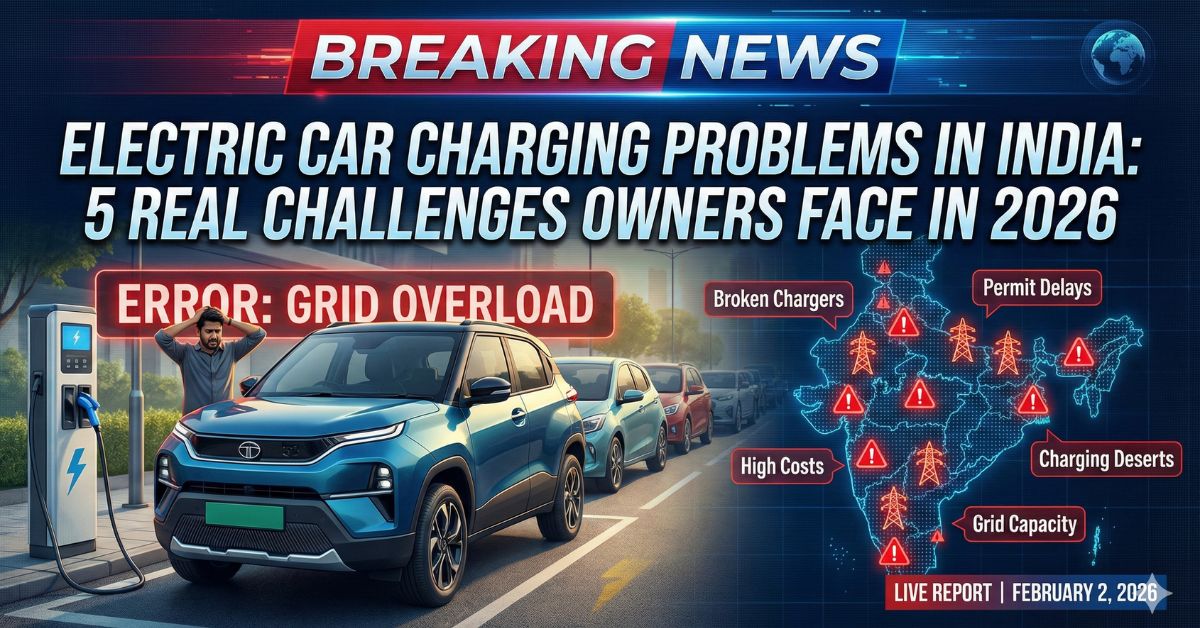
The number of public charging stations in India has crossed 29,000 as of late 2025. On paper, this looks like great progress. However, the ground reality is different.
A recent industry review found that a shocking number of public chargers in major cities like Delhi-NCR, Mumbai, and Bengaluru are frequently non-functional.
- Maintenance Issues: Many chargers have broken screens, damaged guns, or software glitches.
- Power Failures: In smaller towns and highway stops, frequent power cuts mean the charger is technically “there” but has no electricity to give.
- Ghost Stations: Charging apps often show a station as “Available,” but when the driver arrives, the machine is under repair or does not exist at all.
2. The Nightmare of Multiple Apps
One of the most frustrating electric car charging problems in India is the lack of a single payment system. Unlike a petrol pump where you can pay cash or card anywhere, EV charging is fragmented.
To drive from Delhi to Jaipur or Mumbai to Pune, an EV owner often needs to download 5 to 10 different apps (like Tata Power, Zeon, Statiq, Jio-bp, etc.) on their phone. Each app requires a separate wallet balance. There is no universal “tap and pay” card yet that works across all networks, though the government is pushing for interoperability in 2026.
3. Indian Weather vs. Imported Technology
A technical issue that experts are now highlighting is the failure of imported charging hardware. Much of the early charging infrastructure in India was imported from Europe or China, regions with cooler climates.
India’s extreme summer temperatures (often crossing 45°C to 50°C) cause these chargers to overheat. When a charger overheats, it “derates,” meaning it drastically slows down the charging speed to protect itself. A “Fast Charger” that promises to charge your car in 40 minutes might take 2 hours during a hot afternoon in May. Domestic companies are now rushing to build “Made for India” chargers with better cooling systems.
4. The Apartment Charging Struggle
While public charging is tricky, home charging is also a challenge for the majority of Indians who live in apartments.
- RWAs (Resident Welfare Associations): Many housing societies refuse to allow private charging points in shared parking lots due to safety fears or cabling clutter.
- Grid Load: Older apartment complexes often do not have the sanctioned load to support multiple high-power wall-box chargers running at night.
5. What is the Government Doing? (Official Updates)
The Government of India is aware of these roadblocks and has launched new initiatives to fix them:
- PM E-DRIVE Scheme: Replacing the old FAME subsidy, the new PM E-DRIVE scheme has allocated ₹2,000 crore specifically for installing public charging infrastructure. This aims to install nearly 72,000 new public chargers.
- Standardization: The Ministry of Power is enforcing strict rules for “Interoperability.” This means charging networks must allow users to pay through a unified interface (like UPI) rather than forcing them to use proprietary apps.
- Battery Swapping Guidelines: In early 2025, new guidelines were released to standardize battery swapping, which is a big relief for electric two-wheeler and three-wheeler owners, though it is less relevant for private electric cars.
What Happens Next?
The year 2026 is critical. Industry experts believe that the “Wild West” phase of EV charging is ending. We will see consolidation—smaller, unreliable charging players will shut down, and big players (like Tata, Jio-bp, and Adani) will expand reliable networks.
Read More : Automobile Trends 2026
For now, if you are planning a long road trip in an EV, the best advice is to check recent reviews of charging stops on apps like PlugShare before you start your engine.
Frequently Asked Questions (FAQs)
Q1: Why do electric car chargers fail so often in India?
A: The main reasons are poor maintenance by operators, unstable electricity supply from the grid, and overheating of equipment during Indian summers.
Q2: Can I charge my electric car at any station?
A: Technically, yes, if the plug fits (most cars use CCS2 standard). However, you usually need the specific mobile app of that company to start the charging and make the payment.
Q3: Is it safe to charge an EV in the rain?
A: Yes. Electric cars and charging stations are designed to be waterproof and have multiple safety layers to prevent electric shocks, even during heavy rain.
Q4: How much does it cost to fully charge an electric car in India?
A: It depends on the battery size and electricity rate. At home, it might cost ₹300–₹500. At a public fast charger, it is more expensive, typically costing between ₹1,000 and ₹1,500 for a full charge.
Q5: What is the PM E-DRIVE scheme?
A: It is a new Indian government scheme launched to promote electric mobility. It provides funds to set up thousands of new, reliable public charging stations across India.