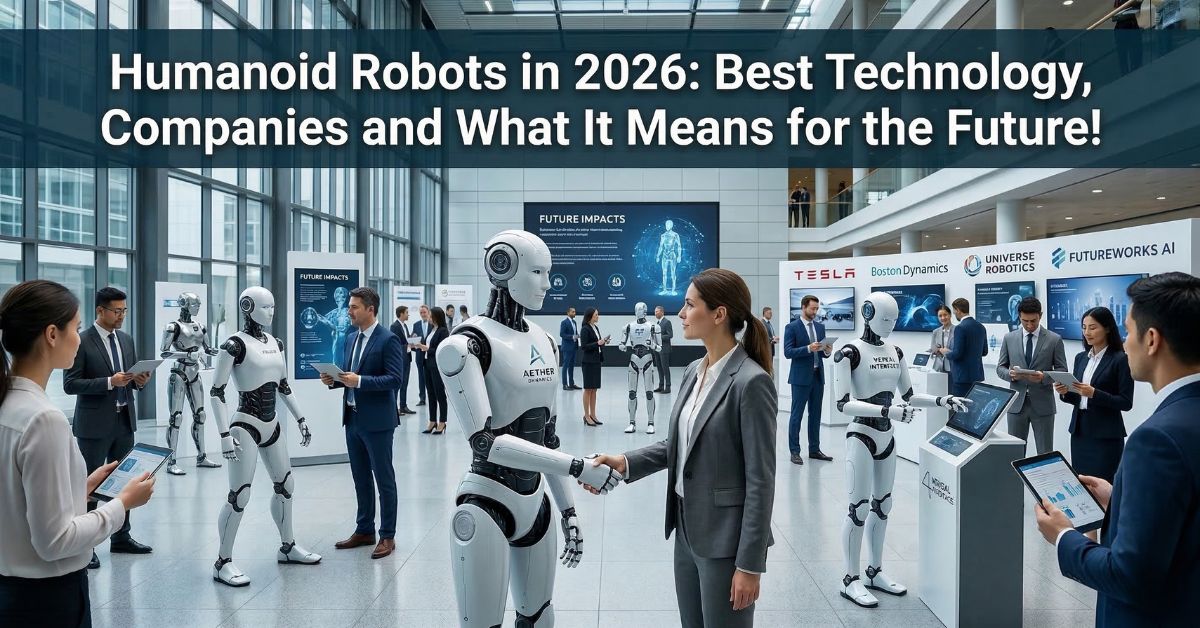
Humanoid Robots in 2026—machines designed to look and move like humans—are becoming one of the most talked-about technologies in 2026. After years of research, companies and governments around the world are now testing these robots in factories, logistics, healthcare, and even everyday service tasks.
This article explains what humanoid robots are, the latest developments in 2026, which companies are leading the race, and what this technology could mean for India and the global economy.
What Are Humanoid Robots in 2026 ?
Humanoid robots are robots built with a body structure similar to humans, including two arms, two legs, and a head-like sensor system. The idea is to create machines that can work in environments designed for humans, such as factories, offices, hospitals, and homes.
Unlike traditional industrial robots that stay fixed in one place, humanoid robots are designed to walk, lift objects, interact with people, and perform multiple tasks. Their human-like design helps them use tools and spaces already built for human workers.
Experts say this flexibility is why companies are investing heavily in the technology.
Major Breakthroughs in Humanoid Robots in 2026
The year 2026 is considered a turning point for Humanoid Robots in 2026 . Many companies are moving from prototypes to real-world trials and early deployments.
For example, technology firms are already testing humanoid robots in factories. A recent trial in China used humanoid robots as “interns” at an electric vehicle plant, where the robots completed more than 90% of assigned tasks during a three-hour shift.
Researchers and companies are also developing new AI systems that allow robots to learn from videos and adapt to unpredictable environments, which has been a major challenge in robotics.
These developments show that humanoid robots are slowly moving from experimental technology to practical tools for industry.
Companies Leading the Humanoid Robot Race
Dozens of technology companies are now competing to build the most advanced humanoid robots. Experts estimate that around 30–50 companies globally are working on humanoid robotics projects.
Some of the most prominent players include:
Tesla
Tesla’s humanoid robot project, called Optimus, is designed to perform factory work and eventually household tasks. The company plans to deploy thousands of these robots in manufacturing and may sell them commercially in the future.
Boston Dynamics
Known for its advanced robotics research, Boston Dynamics has developed the AtlasHumanoid robots in 2026 are moving from labs to factories and real jobs. Explore the latest technology, companies leading the race, and what it means for India., which is famous for its balance and mobility.
Figure AI and Agility Robotics
These startups are building Humanoid Robots in 2026 for logistics and warehouse operations.
Chinese robotics companies
China has been rapidly expanding its robotics industry, with several companies testing humanoid robots in manufacturing environments.
Overall, the competition between the US, China, and other tech hubs is accelerating innovation in this sector.
Why Companies Are Investing in Humanoid Robots
Several global trends are driving the growth of humanoid robots.
First, many industries face labor shortages, especially in repetitive or physically demanding jobs. Robots can help fill these gaps.
Second, advancements in artificial intelligence have made robots smarter. Modern AI systems can analyze video data, understand environments, and learn new tasks much faster than earlier robots.
Third, falling hardware costs and improved computing power are making robots more practical for businesses.
A recent automation survey found that 69% of decision-makers are either adopting or planning to adopt humanoid robots in industries like manufacturing, logistics, healthcare, and customer service.
Humanoid Robots in 2026 and India’s Role
India is also entering the robotics race. Research organizations and technology institutes are exploring new technologies for humanoid robots.
For example, scientists in India have developed artificial robotic skin with tactile sensors that can detect pressure and touch. This innovation could help robots interact more safely with objects and people.
Indian universities and technology events are also showcasing humanoid robots and robotics systems, highlighting growing interest in the field.
With its strong IT and engineering talent, India could play an important role in robotics software, AI systems, and robotics manufacturing in the future.
Challenges Still Facing Humanoid Robots
Despite the excitement, humanoid robots still face several challenges before becoming common.
One major issue is reliability. Robots must be able to work safely around humans and adapt to complex environments.
Cost is another barrier. Advanced robots can still be expensive to produce and maintain.
Finally, there are concerns about how robots could impact jobs. While some experts believe robots will replace certain tasks, others argue they will mainly assist human workers and increase productivity.
What Happens Next?
Experts believe the next few years will be critical for humanoid robotics.
Many companies plan to expand testing in factories, warehouses, and service environments. If these trials succeed, humanoid robots could become widely used in industries such as logistics, healthcare, retail, and manufacturing.
Read More : Tech Predictions in 2026
Some analysts even predict that Humanoid Robots in 2026 could become as common as smartphones in the long term.
For now, 2026 appears to be the year when humanoid robots started moving from science fiction toward everyday reality.
FAQs(Humanoid Robots in 2026)
What is a humanoid robot?
A Humanoid Robots in 2026 is a robot designed with a human-like body structure, including arms, legs, and sensors, allowing it to perform tasks similar to humans.
Are humanoid robots already being used in real life?
Yes. Some companies are already testing humanoid robots in factories, warehouses, and research environments.
Which company is developing humanoid robots?
Major companies include Tesla, Boston Dynamics, Figure AI, and several Chinese robotics firms.
Will humanoid robots replace human jobs?
Experts say robots may replace some repetitive tasks, but they are more likely to assist workers and increase productivity.
Can India build humanoid robots?
Yes. India has strong research institutions and AI expertise, and Indian scientists are already working on robotics technologies such as artificial robotic skin.