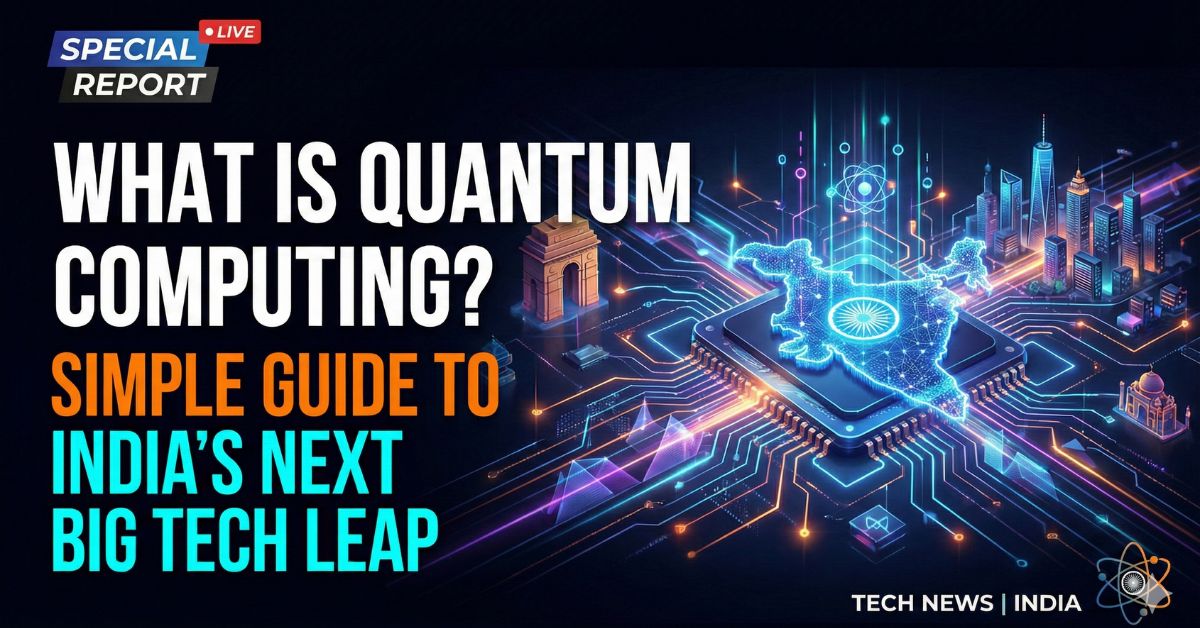
Imagine a computer so powerful that it can solve problems in seconds that would take today’s best supercomputers thousands of years to finish. This is not science fiction—it is the reality of Quantum Computing.
Recently, the Indian government accelerated its focus on this technology through the National Quantum Mission (NQM). With a massive budget of over ₹6,003 crore, India is racing to build its own quantum computers. But what exactly is this technology, and why does it matter to the common man, the banks, and the military?
Here is everything you need to know about Quantum Computing in simple English.
What is Quantum Computing? (Simple Explanation)
To understand quantum computers, we first need to look at the computer or phone you are using right now.
- Classical Computers (The Old Way): Your laptop runs on “bits.” Think of a bit like a light switch—it is either ON (1) or OFF (0). Every app, photo, and website is made of millions of these 1s and 0s.
- Quantum Computers (The New Way): These machines run on “Qubits” (Quantum Bits). Unlike a regular bit, a Qubit can be 0 and 1 at the same time.
The Coin Analogy: Imagine spinning a coin on a table.
- Classical Bit: The coin falls flat and shows either Heads (1) or Tails (0).
- Quantum Qubit: The coin is still spinning. It is a blur of both Heads and Tails simultaneously.
Because Qubits can exist in multiple states at once (a concept called Superposition), a quantum computer can calculate millions of possibilities all together. A normal computer has to check them one by one.
Why is India Pushing for Quantum Tech Now?
The Indian government officially launched the National Quantum Mission (NQM) to make India a global leader in this field. Here is why this is a big deal:
1. The ₹6,000 Crore Plan
The government has approved a budget of ₹6,003.65 crore (approx. $720 million) for this mission. The goal is not just research but building actual quantum computers in India within the next 8 years.
2. The Four “T-Hubs”
To make this happen, four specialized centers (Thematic Hubs) have been set up at India’s top institutes:
- IISc Bengaluru: Focusing on Quantum Computing devices.
- IIT Madras: Working on Quantum Communication (secure internet).
- IIT Bombay: Focusing on Sensing and Metrology.
- IIT Delhi: Working on Quantum Materials.
3. National Security & Defense
This is the most critical reason. Quantum computers are so powerful they could potentially break the passwords and encryption used by banks and armies today. India wants to build “Quantum Safe” networks to protect its digital borders before other countries develop the tech to hack them.
Real-World Impact: How Will It Change Our Lives?
You won’t be using a quantum computer to check Instagram, but its effects will be felt everywhere:
- Faster New Medicines: Scientists currently take years to discover new drugs because simulating chemical reactions is hard. Quantum computers can simulate molecules perfectly, potentially finding cures for cancer or new viruses in weeks.
- Better Weather Forecasting: India relies heavily on the monsoon. Quantum computers can analyze vast weather data instantly, giving farmers far more accurate rainfall predictions.
- Smarter Traffic & Logistics: They can calculate the absolute best routes for millions of trucks and delivery partners simultaneously, reducing traffic and fuel costs.
- Banking Security: As mentioned, they will create unhackable communication channels for financial transactions.
The Roadmap: What Happens Next?
India has a clear timeline set by the National Quantum Mission:
- Next 3 Years: Build small quantum computers with 20–50 physical qubits.
- Next 5 Years: Scale up to 50–100 qubits.
- Next 8 Years: Achieve powerful computers with 50–1,000 qubits.
Currently, big global companies like Google, IBM, and startups in India are also racing to reach these milestones.
Read More : Cashless India 2.0
FAQs about Quantum Computing
Q1: Will a quantum computer replace my laptop?
A: No. Quantum computers are giant, complex machines that need to be kept at freezing temperatures (colder than space!). They are meant for scientific research and big data problems, not for browsing the internet or gaming.
Q2: Is India the only country working on this?
A: No. The USA, China, and European nations are also investing billions. It is a global race, and India is now one of the top contenders.
Q3: What are Qubits?
A: Qubits (Quantum Bits) are the basic building blocks of a quantum computer. Unlike normal bits that are 0 or 1, Qubits can be both at the same time, giving them massive speed.
Q4: Can I buy quantum stocks in India?
A: While you cannot buy “quantum” stock directly yet, many Indian IT giants and deep-tech startups are partnering with the government on this mission. The sector is expected to grow fast.
Q5: Is Quantum Computing dangerous?
A: It carries risks. A powerful quantum computer could theoretically hack into bank accounts or secure government files. That is why India is also working on “Quantum Encryption” to defend against such threats.